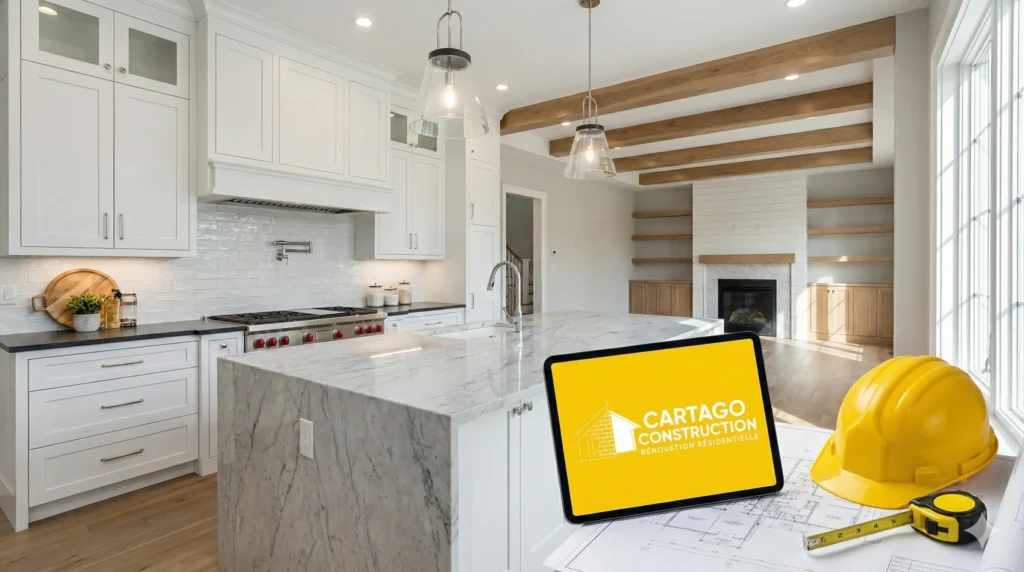
Your kitchen is too small. You don't have enough space to cook, to store your appliances or for the whole family to gather around the island. You've thought about moving, but prices have skyrocketed on the South Shore.
There's another option: extend your kitchen outwards.
It's a popular project in Longueuil and throughout the Montérégie region. In 2025, residential renovations in Quebec increased by 19 % over the previous year. Many of these projects are kitchen extensions. Homeowners are realizing that it makes more sense to invest in their current home than to pay 650,000 $ for a new one, with moving expenses, welcome taxes, and all the stress that comes with it.
But extending a kitchen outwards isn't as simple as knocking down a wall. There are permits to obtain, zoning rules to comply with, and foundations to plan for. Do it without a plan, and you run the risk of a permit refusal, unforeseen costs, or worse, a structure that will cause you problems for years to come.
In this guide, we explain exactly how to extend your kitchen to the outside in Longueuil: municipal bylaws, actual costs in 2025, construction steps, and mistakes to avoid. Everything you need to know before taking the plunge.
Why more and more Longueuil homeowners are choosing to extend their homes
Kitchen expansion has become one of the most popular renovations on the South Shore.
The reasons are clear: the real estate market is crazy, families need space, and a well-designed modern kitchen really does change the quality of everyday life.
A real estate market that encourages renovation rather than relocation
House prices in Longueuil rose by 9.1 % in 2024. The average price of a single-family home is around 550,000 $ to 650,000 $, depending on the sector.
For many families, moving is no longer a realistic option. When you calculate notary fees, welcome taxes (the transfer tax can reach 10,000 $ to 15,000 $ on a 600,000 $ house), moving expenses, repairs to be made in the new house... it quickly adds up to 50,000 $ or 60,000 $ before you've even moved in.
For the same budget, you can expand your kitchen by 200 to 300 square feet, add a double island, install floor-to-ceiling windows, and create a bright, functional living space. You stay in your neighborhood, your kids keep their friends, you know the neighbors, and you have a home that's exactly what you need.
This explains the 19 % increase in renovations in Quebec. Homeowners, especially families in the 30-50 age bracket, are investing in their existing homes rather than chasing the market.
The concrete benefits of a kitchen extension lead
Extending a kitchen outwards isn't just a question of space. It's also a question of light, functionality and value.
- More natural light. By adding an extension, you can install large windows, patio doors, or even skylights. This completely changes the feel of the kitchen. No more cooking under yellow neon lights all day. You get real daylight, which makes the space more pleasant and healthier.
- A family living space. An enlarged kitchen isn't just a place to prepare meals. It becomes the heart of the home. You can install a double island where the kids do their homework while you prepare supper. You can add a dining area with a large table. You can create an open-plan area overlooking the living room, so the whole family can be together.
- Increased resale value. An enlarged, well-designed kitchen can increase the value of your home by 6 % to 12 %, depending on the quality of the workmanship and the neighborhood.. On a 550,000 $ house, this represents between 33,000 $ and 66,000 $ of added value. Even if you invest 70,000 $ in the project, you'll get a good portion back on resale, and in the meantime, you'll enjoy a much more pleasant living space.
Essential rules before enlarging your kitchen in Longueuil
Before you start dreaming of big windows and quartz islands, make sure your project is legal and complies with municipal bylaws.
Many homeowners skip this step and end up with permit refusals, fines, or work to redo. Here's what you need to know.
Mandatory permits and actual lead times in 2025
In Longueuil, any extension over 10 square metres (about 108 square feet) requires a building permit.
Even if you're only enlarging by 12' x 10' (120 ft²), you need a permit. No exceptions.
The time it takes to obtain an extension permit in Longueuil is generally between 20 and 40 working days, depending on the complexity of the project and the workload at the Urban Planning Department. Sometimes it's faster if your file is complete and there are no complications. Sometimes it takes longer if the file is incomplete or if your project requires a minor derogation.
Permit fees vary according to the value of the work. Count on approximately 0.50 $ to 1 $ per square foot of extension, plus a fixed administrative fee of approximately 200 $ to 400 $. For a 250 ft² extension, that works out at about 125 $ to 250 $ in permit fees, plus 200 $ to 400 $ in admin fees, for a total of 325 $ to 650 $.
If you build without a permit, you risk a fine of 1,000 $ to 5,000 $, and the City can force you to demolish the extension or bring it up to standard. It's not a risk you want to take.
Setbacks, footprints and limits to be respected
Zoning is what determines where and how you can expand on your lot.
In Longueuil, each lot is subject to setback (minimum distance between the building and the lot limits) and right-of-way (maximum percentage of the lot that can be covered by buildings) rules.
- Side setbacks : generally 1 to 2 metres from the side lot line. If your extension touches the side of the house, this setback must be respected. In some neighborhoods, it's stricter.
- Reverse : generally 6 to 8 meters from the rear lot line. If you're extending to the rear (which is most common for a kitchen), you need to leave enough space between the extension and your property line.
- Floor area : In Longueuil, the maximum footprint is generally 40 % of the lot. This means that the total surface area of your house (including the extension) plus all other constructions (garage, garden shed, etc.) must not exceed 40 % of the total surface area of your lot. On a 5,000 ft² lot, this means a maximum of 2,000 ft² of constructions.
Rules vary by neighborhood. In Vieux-Longueuil, lots are often smaller and rules stricter. In Saint-Hubert or Greenfield Park, lots are generally larger and setbacks more generous.
Before drawing your plans, check your zoning with Infolot (Ville de Longueuil's online tool) or call the Urban Planning Department. If you exceed the permitted footprint, you may need to demolish another building (such as an old shed) to free up space.
Required drawings and RBQ standards
To obtain an extension permit, you must provide detailed plans prepared by a professional.
If the extension exceeds 200 sq. ft. or affects the load-bearing structure of the house, the plans must be signed by an architect or engineer. This is a requirement of the Quebec Building Code.
The plans must show: foundations (type, depth, reinforcement), structure (framework, beams, joists, framing), insulation and waterproofing, openings (doors, windows), and integration with the existing house (shared wall, drainage, ventilation).
If your property has clay soil (very common in the Montérégie region), the foundations must be designed to resist soil movement. This may require wider footings, deeper piers, or even screw piles. A structural engineer can assess this and tell you what's required.
As of October 2025, Quebec's new energy standards require a 30 % reduction in energy consumption compared to previous standards. This means superior insulation (minimum R-24 walls, minimum R-40 ceilings), high-performance windows (triple glazing or low-emissivity double glazing), and reinforced airtightness. Your contractor must meet these standards, or your permit won't be issued and inspections won't go through.
How much does a kitchen extension really cost?
Let's talk budget. It's often the first question we're asked: how much does it cost?
The answer depends on a number of factors, but we can give you realistic ranges based on real projects in Longueuil in 2025.
Average prices in Longueuil
In 2025, the average cost to extend a kitchen to the outside in Longueuil will be around 225 $ to 270 $ per square foot, turnkey.
That includes everything: excavation, foundation, structure, roof, windows, insulation, electricity, plumbing, interior finishes (flooring, cabinets, countertops), and paint.
For a 200-square-foot extension (e.g. 20' x 10'), you'll need between 45,000 $ and 54,000 $. For a 300-square-foot extension (e.g., 20' x 15'), cost between 67,500 $ and 81,000 $. For a larger 400 sq. ft. extension (e.g. 20' x 20'), you'll pay between 90,000 $ and 108,000 $.
Most kitchen expansion projects in Longueuil range from 50,000 $ to 100,000 $, depending on size, finishes, and lot complications.
What makes the price vary (and surprises the owners)?
The cost per square foot is an average. But there are factors that can increase the price from 15 % to 30 % over the basic estimate.
Reinforced foundations on clay soil
If your site has clay soil (which is common in the Montérégie region), the foundations need to be reinforced. This can add 15 % to the cost of the foundations, or about 2,000 $ to 4,000 $ more on an average project. If a geotechnical study reveals really problematic soil, the cost can go even higher.
Waterproofing the wall between the house and the extension
When enlarging, you need to cut into the existing exterior wall of your home to create the opening to the new kitchen. This wall must be perfectly watertight after the work. You need to install a new air and vapour barrier membrane, seal all joints and make sure that rainwater doesn't penetrate. If this isn't done properly, you'll end up with mold, condensation and insulation problems. A serious contractor will do it right, but it takes time and quality materials.
Relocation of plumbing and electrical systems
If your current kitchen has plumbing pipes and electrical wiring running through the wall you're about to demolish, you'll have to relocate everything. This can add 3,000 $ to 8,000 $ depending on the complexity. Sometimes you also need to increase the capacity of the electrical panel if you're adding a lot of new circuits.
Complex roofing
If your house has a multi-gabled roof or a particular architectural style, connecting the new roof can be complicated. Slopes, soffits and gutters have to be harmonized. This can add 2,000 $ to 5,000 $ to a simple roof.
Quality finishes
Standard melamine vs. custom solid wood cabinets. Laminate vs. quartz or granite countertops. Vinyl flooring vs. engineered oak flooring. Basic appliances vs. high-end appliances. All this adds up to a final price ranging from 20 % to 40 %.
Extension or interior redevelopment: what's in your budget?
Before embarking on an extension, ask yourself: do I really need to enlarge, or can I rearrange the existing space?
If your budget is less than 50,000 $
An interior redesign probably makes more sense. You can knock out a non-load-bearing wall to open up the kitchen to the living or dining room. You can rearrange cabinets and appliances to optimize space. You can install new cabinets, a new island, new countertops, and completely redo the kitchen without touching the exterior. It usually costs between 30,000 $ and 50,000 $ for a medium-sized kitchen.
If your budget is over 50,000 $
expansion becomes an attractive option. For 60,000 $ to 80,000 $, you can add 200 to 300 square feet of real space, install large windows for more light, and create a modern, spacious family kitchen.
The ROI (return on investment) is often better for a well-done extension than for a simple refit, because you're adding living space to the house. Buyers are willing to pay more for a home with a large, bright and functional kitchen.
Key steps to a successful kitchen extension
Now that we know the rules and the costs, let's take a look at a kitchen extension project from start to finish.
At Cartago Construction, we follow a clear, structured process to avoid problems and meet deadlines.
Analysis of land and certificate of location
The first step is to check that your project is feasible on your plot.
We start by obtaining your certificate of location. If you don't have one, or if it's more than 10 years old, you'll need to have it updated by a land surveyor. This costs between 800 $ and 1,500 $.
The certificate of location shows the exact boundaries of your lot, the location of your house, existing setbacks, easements and any legal constraints. It's essential to verify that the extension complies with zoning regulations.
We calculate the current footprint (surface area of the house + garage + other buildings) and check how much space you can add without exceeding the maximum allowed. We measure side and rear setbacks to ensure that the extension respects minimum distances.
Common mistake: many homeowners start drawing plans without checking the certificate of location, only to discover too late that their project encroaches on setbacks or exceeds the right-of-way. This can delay the project by several weeks and cost a lot of money in plan modification costs.
Functional and bright design
Once we know the project is feasible, we move on to design.
An enlarged kitchen is an opportunity to completely rethink the layout. We generally recommend an open kitchen, with no walls blocking the view into the living or dining room. It makes the space bigger, brighter and more convivial.
A double island is popular: a main island for meal preparation, with sink and cooktop, and a second island or counter-bar for quick meals, kids' homework or morning coffee. This creates two functional zones without cluttering up the space.
For natural light, think about orientation. If the extension faces south or west, you'll get plenty of light. Install large floor-to-ceiling windows, or patio doors that open onto the courtyard. If the orientation is north or east, install more windows or a skylight to compensate.
We work with you to design a plan that fits your lifestyle. Do you cook a lot? Do you entertain often? Do the kids do their homework in the kitchen? Do you want a walk-in pantry? All these questions influence the design.
Construction and integration into existing buildings
Once the plans have been approved and the permit obtained, construction begins.
- Week 1-2: Excavation and foundations. We dig, pour the concrete footings and install the French drain. If the soil is clayey, we follow the engineer's recommendations to reinforce the foundations.
- Week 3-4: Structure and framework. The timber frame is erected, the wall of the existing house is opened to create the connection, and the roof structure is installed. This is the stage when you can really see the extension taking shape.
- Week 5: Roof and windows. The roof membrane, shingles and all windows are installed. The extension is sealed for water and air tightness.
- Week 6-7: Electricity, plumbing, insulation. The electrician and plumber run all the wires and pipes. Insulation is installed in the walls and ceiling to meet 2025 energy standards. The vapour-barrier membrane is installed and all joints are sealed.
- Week 8-10: Interior finishing. We install the drywall, paint, flooring, cabinets, countertops and appliances. Connections are made with the existing kitchen to ensure harmony.
Waterproofing is critical. A continuous air-barrier membrane is installed between the old wall and the new extension. All joints are sealed with specialized tape and sealant. Make sure rainwater runs off properly and doesn't seep into the wall.
For the foundation, there are two main options: concrete slab (cheaper, faster, but no basement) or solid foundation with crawl space or basement (more expensive, but adds storage space or even an extra room if you finish the basement). Most kitchen extensions in Longueuil use a concrete slab, because it's more economical and sufficient for a kitchen.
Final inspections and vendor declaration
Throughout the project, there are municipal inspections: after the foundation, after the framing, and a final inspection before the certificate of conformity is issued.
If everything is done according to RBQ standards and the Building Code, inspections go smoothly. If the inspector finds any non-conformities, these must be corrected before proceeding.
Once all inspections have been completed and the certificate of conformity issued, your extension is officially legal and compliant. This is important for future resales: if you sell your home, you'll need to provide a declaration from the seller stating that all the work has been done with permits and is in compliance. Without a certificate of conformity, the buyer may ask for a price reduction or even cancel the sale.
Common myths about kitchen extension (and the reality)
There are many misconceptions about enlargements. Let's debunk some of the more common ones.
«DIY saves 30-50 %».»
Many homeowners think they can save a lot of money by doing the work themselves.
It's true that you'll save on labour. But beware: if you make mistakes, it can cost a lot more to correct.
Above all, in Quebec, certain work must be done by certified professionals. Electricity must be done by an electrician licensed by the Corporation des maîtres électriciens du Québec (CMEQ). Plumbing must be done by a certified plumber. Structural work must be supervised by an RBQ contractor.
If you do the work yourself without the required certifications, you risk fines from the RBQ, and more importantly, your home insurance may refuse to cover the damage in the event of a problem. And on resale, the buyer may ask for the work to be redone by a professional.
According to industry data, DIY projects that go wrong cost on average 20 % to 40 % more to correct than if the work had been done properly from the start by a qualified contractor.
You can do some things yourself (painting, laying floating floors, installing cabinets if you're handy), but for the foundations, structure, electricity and plumbing, hire the pros.
«All extensions increase value»
It's not automatic. A poorly planned extension can even reduce the value of your home.
If the extension doesn't respect zoning and doesn't have a permit, it's a big problem at resale. The buyer will either ask for a substantial price reduction, or walk away from the transaction altogether.
If the design is wrong (for example, an extension that blocks out all the natural light from the living room, or creates an ill-proportioned space), it can make the house less attractive.
And if the finishes are of poor quality, it can give the impression that the house has been poorly maintained.
A well-designed, compliant and well-executed extension can increase the value by 6 % to 12 %. But a botched extension can lower the value or make the house harder to sell.
«A small extension has no energy impact».»
False: any extension modifies the house's thermal envelope, and therefore its energy efficiency.
If the extension is poorly insulated, you'll lose heat in winter and gain heat in summer. Your heating and air-conditioning bills will rise.
Since October 2025, Quebec's new energy standards require a 30 % reduction in energy consumption. This means your extension must be insulated to at least R-24 for the walls and R-40 for the ceiling. Windows must be high-performance. Air-tightness must be tested.
If you don't meet these standards, you won't pass inspection, and your certificate of conformity won't be issued.
A well-insulated and airtight extension can even reduce your overall energy costs, because you can take the opportunity to improve the insulation of the existing house and install a more efficient heating system.
Why entrust your project to Cartago Construction
Extending a kitchen outwards is a complex project requiring expertise, experience and coordination between several trades.
Cartago Construction has completed dozens of kitchen expansions in Longueuil, Saint-Hubert, Vieux-Longueuil, and all over the South Shore. We know the municipal bylaws, the particularities of Montérégie land, and the RBQ standards by heart.
Local expertise tailored to Longueuil and the Montérégie region
Yassine Troudi, founder of Cartago Construction, has over 10 years' experience in residential construction in Quebec.
We know exactly what the City of Longueuil requires for an extension permit. We know the setbacks, footprint rules, 2025 energy standards, waterproofing and insulation requirements.
We also know the soils of the Montérégie region. We know where clay is a problem, how to reinforce foundations, and how to manage drainage to prevent water infiltration. We've already worked on hundreds of different sites, and we know how to anticipate problems before they arise.
We're members of APCHQ Montérégie (Association des professionnels de la construction et de l'habitation du Québec), which means we have to meet high quality standards and follow ongoing training.
A turnkey, human and transparent approach
At Cartago Construction, we take care of everything, from start to finish.
We start with a free in-home consultation. We assess your property, discuss your needs, give you design ideas, and provide you with a realistic estimate. No unrealistic promises, no high-pressure sales. Just an honest conversation about what's possible and how much it will cost.
Then we prepare all the documents required for the permit: certificate of location (if necessary), architectural plans, specifications. We submit the file to the city and follow the process until the permit is granted.
During construction, we coordinate all subcontractors: excavation, concrete, framework, roofing, electrical, plumbing and finishing. We work with trusted subcontractors we've known for years. You have a single point of contact, and we keep you informed every step of the way.
We respect deadlines and budgets. If something unexpected comes up (for example, a soil problem discovered during excavation), we tell you about it right away, explain the options, and work out a solution together. No hidden costs, no unpleasant surprises at the end.
And we're RBQ certified and fully insured.. All our work complies with the Quebec Building Code and industry standards. You get a legal warranty, liability insurance and peace of mind.
Examples of similar projects
We recently completed a kitchen extension for a family of four in Saint-Hubert. They had a small, enclosed 120-sq.-ft. kitchen, and wanted to expand to the rear to create an open space overlooking the yard.
A 180 ft² (15' x 12') extension was added, floor-to-ceiling sliding patio doors were installed, a double island with quartz countertops was created, and the kitchen was completely opened onto the dining room. Total budget: 65,000 $, including all finishes and appliances.
The result: a 180 ft² space gain, a bright and functional kitchen that has become the heart of the home, and an estimated 8 % increase in the home's value (about 45,000 $ on a 560,000 $ home).
Want a similar project at home? Request a free estimate with Cartago Construction today.
FAQ - Extending your kitchen to the outdoors in Longueuil
Here are the questions we're most often asked about kitchen extensions.
Do I need a permit for a kitchen extension in Longueuil?
Yes, as soon as the extension exceeds 10 square metres (about 108 square feet). Even a small 12' x 10' extension requires a permit. Without a permit, you risk a fine and resale problems.
How long does kitchen extension work take?
On average, between 8 and 12 weeks from start to finish. This includes preparing the permit file, obtaining the permit (20 to 40 days), and the actual construction (6 to 8 weeks, depending on weather and complexity). An experienced contractor can sometimes speed up the process.
Is it possible to enlarge a kitchen in Quebec winters?
Yes, it's possible, but there are constraints. Concrete can't be poured if the temperature drops below -5°C, except with special additives and protective measures (heating tarpaulins, temporary shelters). This increases costs by around 10 % to 15 %. It's generally recommended to plan expansions for spring or summer, but if you're in a hurry, we can do it in winter.
When is the best time to apply for a permit?
Ideally, in February or March, to obtain the permit in April or May and start construction in the spring. That gives you the whole summer to build. If you file the permit in May or June, you'll probably start in July or August, which leaves less time before winter.
Extension or glass roof: what's the difference?
An extension is an extension with solid walls, a solid roof and complete insulation. It's a year-round living space. A glass roof (or solarium) is a glazed space with floor-to-ceiling windows. It's bright, but often less well insulated, so harder to heat in winter. In Longueuil, with its cold winters, we generally recommend a full extension with large windows rather than a solarium, unless you want a three-season space.
Is it profitable on resale?
Yes, if it's done right. A well-designed, compliant kitchen extension can increase the value of your home by 6 % to 12 %. Even if you don't recoup 100 % of your investment at resale, you'll get a good chunk back, and in the meantime, you'll enjoy a much nicer living space. And a house with a large, modern kitchen generally sells faster than one with a small, outdated kitchen.
What subsidies are available in 2025?
There are no specific grants for kitchen extensions, but if you meet high energy standards, you may be eligible for energy-efficient renovation tax credits. The Rénoclimat program also offers rebates if you improve your home's overall energy efficiency. Talk to your contractor or contact Transition énergétique Québec to check your eligibility.
Extending your kitchen outwards in Longueuil is a project that transforms your home and your quality of life.
But you have to plan it properly: respect municipal bylaws, plan a realistic budget, choose a qualified contractor, and follow construction standards.
At Cartago Construction, we're with you every step of the way, from design to completion. We know Longueuil's bylaws, we master the techniques of building on clay soils, and we guarantee you a compliant, durable and magnificent result.
Contact us to discuss your project. Call us at 438-932-4326 or write to [email protected]. Our office is located at 2580 Rue Cartier, Longueuil.
Your dream kitchen starts here.