How much are your heating bills this winter? $300, $400, or sometimes even more per month?
And even when heating to the maximum, you have rooms that remain cold. Walls that are icy to the touch. Condensation on the windows. Perhaps even damp spots in the corners.
That's not normal. And it's probably not just your furnace to blame.
Here in Longueuil, with our winters reaching -16 °C, our 1,159 mm of annual precipitation, and our constant freeze-thaw cycles, a poorly insulated home loses between 25% and 40% of its heat through the exterior walls.
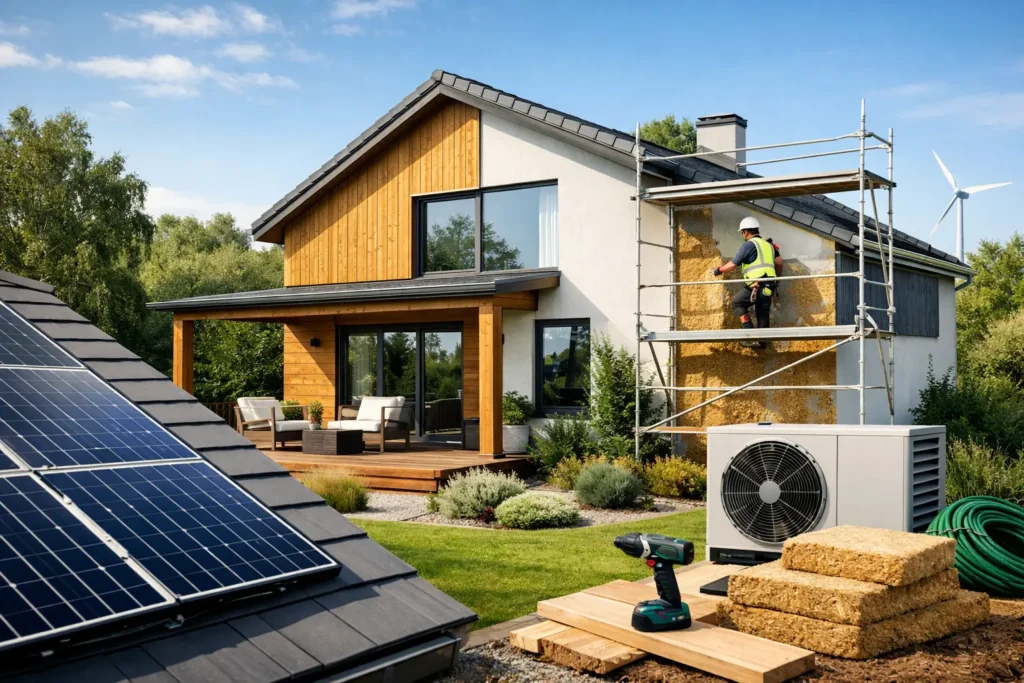
Exterior insulation—known as EWI (External Wall Insulation)—is one of the most effective solutions for addressing this issue. It costs more upfront than interior insulation, but it tackles the problem at its source and can save you 20 to 25% on your heating costs.
And in 2025, with the new Rénoclimat grants, which can be as high as 3,750 $, it has become much more affordable.
We'll show you how it works, what it really costs, what mistakes to avoid, and how to use it to improve your home's comfort in the long term.
Why is exterior insulation crucial in Longueuil
Insulation isn't just about comfort. It's about energy efficiency, the durability of your home, and real savings on your bills.
And in Longueuil, with our climate that changes quite a bit from one season to another, good exterior insulation makes all the difference between a pleasant home to live in and a home where you freeze in the winter and bake in the summer.
Longueuil's climate: freeze-thaw, humidity, and thermal losses
The climate in Montérégie is demanding. We have cold winters with temperatures regularly dropping to -20°C and below. We have hot, humid summers. And above all, we have freeze-thaw cycles that repeat endlessly between November and March.
These cycles are the enemy of your exterior walls.
Moisture seeps into the micro-cracks in your walls. At night, it freezes. The water turns into ice and expands, widening the cracks. During the day, it thaws, and the water penetrates deeper. In the evening, it freezes again.
With 1,159 mm of precipitation per year, rain, snow, ice, water always finds its way. And if your exterior insulation is deficient or non-existent, this moisture directly affects your comfort and your heating costs.
Houses built between 1950 and 1990 in Longueuil often have very little insulation in the walls; sometimes just 2 inches of mineral wool, sometimes nothing at all. These houses lose a tremendous amount of heat through the walls.
Result? You're heating your lot instead of your house. Your bills go up. Your walls stay cold. And you have condensation problems that can lead to mold.
Thermal bridges: the real source of high bills
You know what really skyrockets your heating costs? It's not just a general lack of insulation. It's thermal bridges.
A thermal bridge is a place where heat escapes much faster than in the rest of the wall. It's like a highway for heat loss.
Typical locations? Rim joists (where the floor meets the exterior wall), junctions between floors and walls, window corners, and wood or metal structural connections.
If these areas aren't properly insulated, they can account for 10 to 25% of your total heat loss. That's a huge amount.
The problem with traditional interior insulation, ITI, is that it doesn't address thermal bridges. You insulate between the wall studs, but the studs themselves, the joists, the structural connections remain direct pathways for heat to escape.
Exterior insulation, on the other hand, wraps the entire house in a continuous insulating layer. It cuts off these thermal bridges at the source. That's why it's so much more effective.
I’ve seen homes in Saint-Hubert where 3 inches of exterior insulation were added to walls that already had interior insulation. The homeowners saw their heating bills drop by 30% as early as the first winter. That’s because we eliminated the thermal bridges.
Exterior vs. Interior Insulation: What the Quebec Building Code Favors
There is a lot of confusion about what is better: insulating from the inside or from the outside.
The answer depends on your situation. But Quebec's building codes are becoming increasingly clear: exterior insulation is preferred for major renovations.
Ce que dit le Code de construction du Québec (RBQ)
The Quebec Construction Code is based on the National Building Code (NBC) with specific modifications for our climate.
For exterior walls in the Longueuil region, the Code recommends an RSI value between 4.31 and 5.11 (approximately R-24 to R-29 in imperial units).
Longueuil is part of a high climate zone, with approximately 6,000 heating degree-days per year. This is a measure of the severity of our winter. The higher the number, the longer and colder the winter.
Because of this, insulation requirements are stricter here than in more southern regions of Quebec.
The Code now favors continuous exterior insulation for major renovations because:
It eliminates thermal bridges. It protects the building's structure from freeze-thaw cycles. It moves the dew point to the outside, reducing the risk of condensation inside the walls. It preserves interior living space.
If you are renovating your home and making changes to more than 50% of the exterior envelope, you must comply with these standards. An RBQ-certified contractor like Cartago Construction is familiar with these requirements and will ensure that your project is in compliance.
Myth or reality: does external insulation cause moisture?
It's a common myth we hear: «If I insulate on the outside, I'll trap moisture in my walls.»
That's false. In fact, it's the exact opposite.
Exterior insulation shifts the dew point, the spot where warm air meets cold air and creates condensation, to the outside of the wall, into the insulation or on the exterior surface.
Result? The interior of your wall structure stays warm and dry. No condensation. No mold.
With poorly done interior insulation, the dew point is often found inside the wall, between the insulation and the exterior cladding. Moisture condenses, the wood rots, and mold develops.
I've seen cases in Longueuil where owners added interior insulation in the 80s-90s without an adequate vapor barrier. When the walls were opened 20 years later, they were full of mold. The wood was rotten.
With exterior insulation, if done correctly with a weather-resistant barrier and proper ventilation, you have a healthy structure that breathes outward.
The key is to work with a contractor who understands building science. At Cartago Construction, we always install the right membranes, we respect moisture management principles, and we strictly follow RBQ standards.
What exterior insulation solutions are suitable for Longueuil
Not all exterior insulation is created equal. Some are excellent for foundations, others for above-ground walls. Some better withstand freeze-thaw cycles, while others offer better insulating value.
Here are the main options for Longueuil and what really works in our climate.
Extruded Polystyrene (XPS): Ideal for Foundations and Freeze-Thaw Cycles
Extruded polystyrene, XPS, is the champion for insulating foundations from the outside.
Why? Because it perfectly resists moisture and soil pressure. It retains its insulating properties even in direct contact with damp soil.
XPS has an insulating value of about R-5 per inch. This means that 2 inches of XPS gives you R-10, and 3 inches gives you R-15.
This is particularly important for foundations in Longueuil. If your foundations are not insulated, you lose a lot of heat through the basement. And in winter, freeze-thaw cycles can cause cracks and water infiltration.
By insulating your foundations from the outside with XPS, you protect the concrete from freeze-thaw cycles, reduce heat loss, and keep your basement more comfortable.
Cost: approximately $3.10 to $7.10 per square foot installed, depending on the thickness and complexity of the work (excavation, drainage, etc.).
For above-ground walls, XPS can also be used, but there are often better, more economical options.
Rigid EPS and high-performance panels for above-ground walls
For above-ground walls, everything above ground level, expanded polystyrene (EPS) and high-performance insulation panels are generally the best choices.
EPS is white polystyrene, lighter than XPS. It costs less and offers good insulating value, around R-4 per inch.
With 4 inches of EPS, it provides R-16. With 6 inches, it goes up to R-24. This is more than enough to meet the Quebec Building Code standards.
EPS holds up well to freeze-thaw cycles. It allows some water vapor to pass through, which is good for the wall's health. And it costs less than XPS for above-ground applications.
High-performance insulation panels, such as polyisocyanurate panels or composite systems, offer even higher R-values. You can achieve R-20 to R-30 with as little as 3 to 5 inches of thickness.
These systems are perfect if you have space constraints or want to maximize energy efficiency. However, they are more expensive.
Typical cost for insulating above-ground walls with EPS or high-performance panels: $10.40 to $25.40 per square foot installed, including installation, rain screen, furring strips, and preparation for the final finish.
It's an investment, but when you calculate the energy savings over 20-30 years, the return on investment is there.
Bio-based insulation: a sustainable but regulated option
Bio-based insulation, like wood fiber panels, is gaining popularity among homeowners looking for eco-friendly solutions.
These materials are made from renewable resources, they store carbon, and they offer good thermal and acoustic performance.
Wood fiber boards have an R-value of approximately R-3.5 to R-4 per inch. They regulate humidity well and create a healthy indoor environment.
On the other hand, they generally cost more than EPS and require more careful installation to manage moisture properly.
In Longueuil, given our humid climate and freeze-thaw cycles, bio-sourced insulations can perform well, but they must be adequately protected from water. A quality house wrap and proper ventilation are essential.
At Cartago Construction, we particularly recommend bio-based insulation for projects where environmental sustainability is a priority and the client understands the installation and maintenance requirements.
For most residential projects in Longueuil, EPS or XPS remain the most reliable and economical choices.
Key steps for successful exterior insulation (without mistakes)
Exterior insulation isn't just about putting panels on your walls and adding new siding over them.
This is a complete system that must be designed and installed correctly to function. Here's how we do it at Cartago Construction.
Thermal diagnostic and pre-inspection
Before we begin, we'll inspect your house in detail.
We are looking at the current condition of your exterior walls. Are there any cracks? Signs of water infiltration? Wood rot? Structural problems?
We also check the existing insulation if possible. Many houses from the 1950s to the 1990s in Longueuil have very little insulation, sometimes just 2 inches of mineral wool, sometimes none at all.
If your house has existing moisture in the walls, you need to fix that before insulating. Otherwise, you'll trap the problem and it will get worse.
We also identify the main thermal bridges: joist ends, floor junctions, window corners, structural connections. These areas will receive particular attention during installation.
Ideally, a Rénoclimat energy assessment is performed or recommended before the work begins. This gives you a precise picture of your energy losses and makes you eligible for grants.
Installation of continuous insulation (perfect wall)
Once the inspection is complete and the existing problems are corrected, the insulation jacket is installed.
The principle of the «perfect wall» or continuous envelope is that there are no holes or thermal bridges. The insulation covers the entire exterior surface without interruption.
First, an air barrier is installed if necessary to control air infiltration. Then, rigid insulation panels are installed, XPS for foundations, EPS or high-performance for above-grade walls.
The panels are mechanically fastened with screws or special fasteners. The joints between the panels are sealed to ensure continuity.
Next, a breathable moisture barrier is installed over the insulation. This is critical. The moisture barrier protects the insulation and the structure from water, but it allows water vapor to escape outward.
Furs, wooden or metal battens are then installed to create a ventilation space between the insulation and the final cladding. This space allows moisture to escape and prevents mold problems.
Every detail counts: the seals around windows and doors, the connections between walls and roof, the rim joists. If these areas aren't handled correctly, you'll have thermal bridges that negate a good portion of your efforts.
Finishing, cladding, and winter protection
Once the insulation system is in place, the final exterior cladding is installed.
It can be fiber cement, insulated vinyl, metal, engineered wood, depending on your preferences and budget.
If you choose a render on insulation, such as modern rendering or stucco, a fiberglass mesh is applied over the insulation, followed by one or two coats of finishing render.
The advantage of stucco over insulation is that it gives a contemporary European look and offers additional protection against the elements. However, it costs more than vinyl or fiber cement.
If you are doing the work in the fall or spring, you must plan for protection against bad weather. You can install temporary tarps, work in sections to minimize exposure, or schedule sensitive steps during periods of good weather.
In Quebec, exterior insulation work is ideally done between May and October. Materials are easier to install, sealants adhere properly, and cold-related complications are avoided.
If you absolutely must do the work in winter, it's possible with special precautions, but it costs more and takes more time.
Do you want to know if your house is a good candidate for exterior insulation? Request a free assessment in Longueuil,We are coming to inspect your walls, assess your situation, and advise you on the best approach.
Actual Costs and Available Subsidies in Longueuil
Exterior insulation is an investment. But it's an investment that pays for itself over time through energy savings.
And in 2025-2026, with the Rénoclimat subsidies available, it became much more accessible.
What is the cost of exterior insulation in 2025-2026
Costs vary depending on several factors: the size of your home, the current condition of your walls, the type of insulation chosen, architectural complexity, and the type of finish.
Here are the typical ranges for a residential house in Longueuil:
Exterior foundation insulation (XPS): 5,000 $ to 12,000 $
This includes excavation, insulation installation, mechanical protection, and backfilling. For a typical house with a foundation perimeter of 120 to 150 linear feet.
Above-ground wall insulation (EPS + cladding): 15,000 $ to 40,000 $
For a single-family home of 1,200 to 2,000 square feet of wall surface. This includes insulation, house wrap, furring strips, and new siding (vinyl or fiber cement).
Complete system (foundations + walls): 25,000 $ to 55,000 $
For a complete envelope on a typical South Shore house.
It's more expensive than interior insulation, that's for sure. But remember that exterior insulation:
- Eliminate thermal bridges
- Protects your structure
- Gives you a new exterior coating at the same time
- Increase the resale value of your home
- Generates energy savings of 20 to 25 % per year
Over 15-20 years, the return on investment is there.
Rénoclimat Subsidies: What You Can Recover
The Rénoclimat program offers attractive grants for exterior insulation in 2025-2026.
Here's how it works:
You’ll conduct a pre-renovation energy assessment with a Rénoclimat advisor (cost: approximately $300 to $500, but covered by grants).
You are carrying out your insulation work with a certified RBQ contractor.
You are doing a second post-work assessment to confirm the improvements.
You receive your grant based on the energy savings achieved.
For exterior wall insulation, grants range from 450 to 3,750, depending on the scope of the work.
There is one requirement: you must insulate at least 20 % of the total surface area of your exterior walls to be eligible.
If you combine exterior insulation with other work, such as roof insulation, window replacement, or heating system upgrades, the subsidies can be even higher.
At Cartago Construction, we are well aware of the Rénoclimat program. We can guide you through the process and ensure your work meets the eligibility criteria.
Check your eligibility for Rénoclimat grants in Longueuil for free, contact us and we'll help you build your file.
Common mistakes to avoid (and how to prevent them)
Exterior insulation, when done correctly, transforms a home. When done incorrectly, it can cause more problems than it solves.
Here are the most common mistakes and how to avoid them.
Insulate the rim joists and connections from below
Junctions where floor joists meet exterior walls are some of the worst thermal bridges in a house.
If you insulate your walls but forget the rim joists, you're leaving a highway for heat loss. It's like putting on a warm coat but leaving your wrists exposed.
The typical mistake? The contractor installs insulation on the above-ground walls but stops just before the rim joists because it's more complicated to access.
The right way? You insulate the rim joists at the same time as the rest of the wall, with the same level of thermal performance. It requires more work, but it's essential.
The same applies to the joints between floors, around windows and doors, and at the corners of the house. Every joint must be treated with care.
Choosing the wrong material for foundations
I've seen cases where contractors used EPS to insulate foundations from the outside. The problem? EPS absorbs some water. In contact with damp soil, it loses its insulating properties over time.
For foundations, you need XPS or polyisocyanurate, materials that resist moisture without losing their R-value.
For above-ground walls, however, EPS is perfect and more economical.
Choosing the right material for the right application is crucial. An experienced contractor knows these differences.
Neglecting ventilation after construction work
When you improve your home's insulation, you make the building envelope tighter. This is good for energy efficiency, but it can create ventilation problems if you don't adjust your system.
A well-insulated but poorly ventilated house will accumulate humidity, odors, and indoor pollutants. You may experience window condensation, mold in corners, and degraded air quality.
After major insulation work, mechanical ventilation often needs to be added or improved. An HRV (heat recovery ventilator) is ideal: it exhausts stale air and brings in fresh air while recovering heat to avoid wasting energy.
It's not always mandatory, but it's highly recommended. And the Rénoclimat advisors will often suggest it in their report.
Do you want to avoid these mistakes on your project? Talk to a certified local RBQ expert,At Cartago Construction, we ensure that every detail is handled correctly, from design to finishing.
Why entrust your work to Cartago Construction
Exterior insulation is technical. It requires experience, in-depth knowledge of the building, and meticulous execution.
Many entrepreneurs offer this service, but few truly master it. At Cartago Construction, it's one of our specialties.
Local RBQ expertise and knowledge of the Longueuil built environment
Yassine, the founder, has over 10 years of experience in residential construction and renovation in Quebec. He knows the houses of Longueuil and the Montérégie region like the back of his hand.
1960s bungalows with their uninsulated foundations. 1980s cottages with their poorly insulated walls. Poorly integrated extensions that create thermal bridges.
We know what works here, in our climate. We don't apply imported techniques; we use proven methods for Quebec.
We are RBQ certified. We know the Building Code. We adhere to insulation, air barrier, and moisture management standards.
And we know the Rénoclimat program well. We can guide you through the steps to maximize your subsidies.
Turnkey approach, without risky subcontracting
With Cartago Construction, you have a single team responsible for everything.
We coordinate the energy assessment, plan the work, order materials, manage the installation, and ensure quality follow-up.
We've known our subcontractors for years. They are reliable, trained individuals who share our quality standards.
You don't have to deal with five different contractors blaming each other if something goes wrong. You have a single point of contact: us.
We honor our commitments. We provide realistic timelines and stick to them. We communicate clearly throughout the project.
And we treat your home with respect. We protect your flowerbeds, we clean up the site every evening, and we minimize any inconvenience.
Ready to improve your home's insulation? Request a free estimate for your project in Longueuil,Call us at 438-932-4326 or visit cartagoconstruction.ca. We'll come and assess your home and propose a custom plan.
FAQ - Exterior Insulation in Longueuil
Here are the questions we are most often asked about exterior insulation. If your question isn't here, call us, and we'll be happy to answer it.
Is exterior insulation cost-effective in Quebec?
Yes, especially in the long run. You can save $200 to $250 on your annual heating costs. For a typical home in Longueuil that spends $2,000 to $3,000 a year on heating, that amounts to $400 to $750 in savings per year. Over 20 years, that pays for a good portion of the initial investment. And with Rénoclimat grants, the return on investment is even better.
What thickness of insulation is recommended in Longueuil?
For above-ground walls, 3 to 5 inches of EPS or polyisocyanurate are generally recommended to achieve R-15 to R-25. For foundations, 2 to 3 inches of XPS are sufficient to provide R-10 to R-15. The Quebec Building Code requires at least R-24 for walls in our climate zone, so 4 inches of EPS is a good minimum.
Can a house from the 60s be insulated without redoing the entire wall?
Absolutely. That's precisely the advantage of exterior insulation. We work from the outside, so we don't touch the interior of your home. You can stay in your house during the work. We remove the old siding, install the insulation, and put up new siding. No impact on your interior rooms, your finishes, or your daily life.
XPS and EPS are two different file formats used in graphics. Here's the difference: * **XPS (XML Paper Specification)**: This is a document format developed by Microsoft. It's designed for digital documents, similar to how PDF works. XPS files can contain text, graphics, and layout information and are mainly used for printing and document sharing. * **EPS (Encapsulated PostScript)**: This is a vector graphics file format. It's commonly used in desktop publishing, graphic design, and illustration. EPS files can contain both vector and raster graphics and are often used for logos, illustrations, and other artwork that needs to be scaled without losing quality. **In simple terms:** * **XPS is for documents.** * **EPS is for graphics.**
XPS (extruded polystyrene) is denser, more moisture-resistant, and slightly higher performing (R-5 per inch). It costs more and is recommended for foundations or applications in contact with soil. EPS (expanded polystyrene) is lighter, less expensive, and offers R-4 per inch. It's perfect for above-ground walls. Both hold up well to freeze-thaw cycles, but XPS better retains its properties in humid environments.
Is it compatible with the Rénoclimat grant?
Yes, absolutely. Exterior wall insulation is eligible for Rénoclimat grants. You must insulate at least 20% of the total surface area of your exterior walls to be eligible. Grants range from $450 to $3,750 depending on the scope of the work. You must have an energy assessment conducted before and after the work by a certified Rénoclimat advisor.
How long does the work last?
For a typical single-family home in Longueuil, allow 3 to 6 weeks depending on complexity. Foundation insulation alone takes about 1 to 2 weeks (excavation, installation, backfilling). Above-ground walls take 2 to 4 weeks (removal of old cladding, insulation, new cladding). Weather can extend the deadlines, which is why it is recommended to schedule work between May and October.
Can the work be done in winter?
Technically yes, but it's not ideal. Sealants and membranes adhere poorly below 0°C. Materials are harder to handle. And the risks of weather-related delays are high. If it's really urgent, it can be done with special measures (heated tents, cold-adapted products), but it costs more and takes more time. It's better to plan for spring or summer.
Improving the external insulation of your home in Longueuil is one of the best investments you can make for your comfort and finances.
It reduces your heating bills by 20 to 25 percent. It eliminates cold walls, drafts, and condensation problems. It protects your home’s structure from freeze-thaw cycles. And it adds value to your property.
With Rénoclimat grants of up to $3,750, it has become much more affordable. And if you plan your project carefully, you’ll start seeing a return on your investment as early as the first winter.
But for it to really work, it has to be done correctly. The right materials for the right applications. An installation that respects moisture management principles. Attention to detail to eliminate all thermal bridges.
At Cartago Construction, we have the local expertise, RBQ certifications, and turnkey approach that ensure your project goes smoothly. No surprises, no problems, just lasting results.
Do you want to reduce your heating bills and improve your home's comfort? Contact us today for a free assessment., 438-932-4326 or info@cartagoconstruction.ca. We will analyze your situation, explain your options, and help you build a project that makes sense for you.