Planning to renovate your Longueuil home this year?? You're not alone.
In 2024, no fewer than 1,245 renovation projects received Novoclimat certification in the Greater Montreal area, an increase of 28 % over 2023. South Shore homeowners now understand that investing in energy efficiency pays off in the long term.
But here's what many people don't know: energy standards for renovation have changed significantly over the past two years. What was acceptable in 2022 is not necessarily acceptable today.
Why is this important to you? Because a renovation that doesn't meet the new standards could cost you dearly. We're talking high energy bills, missed subsidies (up to 7,500 $ left on the table), and even problems when reselling your property.
The good news? When done right, a retrofit that complies with the new standards can reduce your electricity bill by an average of 25 %. That's about 450 $ per year in your pocket.
At Cartago Construction, we closely follow the evolution of energy standards in Quebec. With over 10 years' experience in residential renovation, our team knows exactly how to optimize your project so that it's compliant, comfortable and economical.
Request a free energy compliance assessment with Cartago Construction-we'll guide you through the new requirements.
Why these new standards affect your renovation project
The Quebec government has tightened its energy efficiency requirements for one simple reason: to meet greenhouse gas reduction targets by 2030.
This means that your renovation project, even if it's just residential, now has to meet higher standards than before. And frankly, that's good for your wallet and your comfort.
Market growth and dynamics in Longueuil
The green renovation market is literally exploding on the South Shore. It's estimated that it now represents more than $120 million in Longueuil and surrounding towns, with annual growth of 15 %.
Why this explosion? Three main reasons.
First, homeowners are more conscious of their energy consumption. With Hydro-Québec's rate hikes in recent years, no one wants to throw their money down the drain-literally.
Secondly, provincial and federal subsidy programs are more generous than they used to be. This makes energy retrofits much more accessible.
Finally, resale value. Today's buyers are looking for efficient homes. Energy certification can increase the value of your property by 5 to 10 %, according to recent studies in the Quebec real estate sector.
According to Transition énergétique Québec (TEQ), some 65 % of major renovations in Longueuil now comply with the new energy standards. That's good, but it also means that 35 % of projects are missing out on the benefits.
What types of renovations are affected by the new standards?
Here's where it gets real. Not all renovations are covered by the new energy standards.
The key term is «substantial renovation». At Quebec, This refers to any project costing more than 10,000 $ and involving the building envelope (exterior walls, roof, foundations, doors and windows).
If you're just redoing your interior kitchen without touching the outside walls, you're generally OK. But as soon as you change your windows, add insulation to the walls, or renovate your roof, the new standards apply.
The types of project most affected:
- House extensions (floor additions, side extensions)
- Roof replacement with new insulation
- Replacement of all windows or a complete section
- Exterior renovation with added insulation
- Basement finishing including insulation and heating system
- Replacing the main heating system
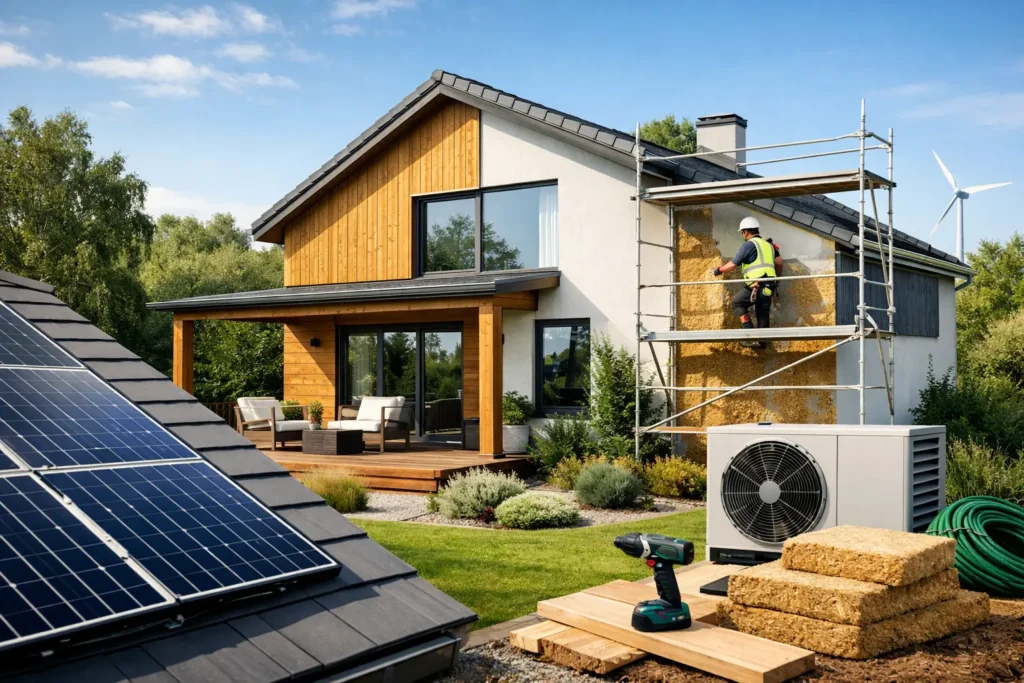
Interesting fact: since 2023, we've seen a 35 % increase in heat pump installations in Longueuil and Saint-Hubert. Homeowners understand that now is the perfect time to upgrade their heating systems while taking advantage of subsidies.
What's in it for you-owner or manager?
In practical terms, what does this mean for your day-to-day life?
More comfort first. A home insulated to the new standards means a stable temperature in every room. No more cold bedrooms on the second floor or icy basements in winter.
Substantial savings. TEQ data show that a home renovated to Novoclimat 2.0 standards consumes an average of 25 % less energy than before. For an average house in Longueuil, this represents savings of around 450 $ per year on the electricity bill.
Over 20 years, we're talking about savings of 9,000 $. That's a lot.
Access to subsidies too. Without compliance with the new standards, you're ineligible for financial assistance programs. We'll come back to this later, but you could be leaving up to 7,500 $ on the table.
Resale value after all. An energy-certified home sells faster and for more money. Buyers are willing to pay a premium for a property that will cost them less to heat.
Receive a complete pre-construction energy diagnostic-a free service with any Cartago Construction project quote.
What you need to know about the new standards
Now we're getting to the heart of the matter. What exactly has changed in the energy standards for renovation?
Here are the four main pillars to understand.
Thermal insulation and building envelope
Insulation is the basis of everything. There's no point in having an efficient heating system if the heat escapes through the walls and roof.
The new requirements are clear:
- For exterior walls: You need to achieve a minimum of R-28 in total insulating value. To give you an idea, that's the equivalent of about 8 inches of fiberglass insulation or 6 inches of polyurethane foam.
- For roofing: We're now talking about a minimum of R-50 in attics. That's a lot more than before. Most houses built before 2015 have just R-30 or R-40.
- For foundations: If you're insulating your basement, you need to achieve at least R-24 on the foundation walls.
- Airtightness: It's new, and it's crucial. Your home must pass a blower door test to ensure that there are no major air leaks. The accepted standard is 2.5 air changes per hour at 50 pascals of pressure.
It may sound technical, but your certified contractor knows exactly how to measure and achieve these values.
Important point for Longueuil: if your renovation affects more than 25 % of the building envelope, you must have a complete energy modeling done. More on this below.
Heat pumps, geoexchange and efficient systems
Heating is the biggest energy consumption item in a Quebec home. No wonder standards have become stricter.
The new rules strongly encourage (and in some cases require) the installation of high-efficiency heating systems.
Heat pumps: This has become the de facto standard in Quebec. A properly sized heat pump can heat your home even when it's -25°C outside, while consuming 3 times less energy than a traditional electric system.
In Longueuil, heat pump installations jumped by 35 % between 2023 and 2024. This is the system we most often recommend to our customers.
Geothermal systems: For more ambitious projects, geothermal energy offers even better performance. It's more expensive to install (20,000 $ to 35,000 $), but the long-term savings are impressive.
High-efficiency hydronic heating: If you keep a central system, it must have an efficiency of at least 95 % (Energy Star certification).
Thermodynamic water heaters: Increasingly popular, they use heat pump technology to heat domestic water with 60 % less energy.
What's important to understand: if you're replacing your main heating system as part of a major renovation, you can't just put the same old system back in. Standards require you to improve efficiency.
Energy modeling and engineering obligations
Here's a new aspect that surprises many homeowners: for certain projects, you now have to have a complete energy modeling of your home done.
What does it mean exactly? It's a computer simulation that calculates your home's energy consumption before and after renovations. It proves that you've met the new standards.
When it's mandatory:
- Renovations involving more than 25 % of the building envelope
- Complete changeover of the heating system as part of a major renovation project
- Projects aiming for Novoclimat or equivalent certification
Modeling must be done by a qualified professional (engineer, technologist or certified energy advisor). He or she will use recognized software such as RETScreen or HOT2000.
How much does it cost? Expect to pay between 800 $ and 1,500 $, depending on the complexity of your home. But the good news is that several subsidy programs reimburse these costs.
At Cartago Construction, we work with certified energy modeling partners. We coordinate everything for you, so all you have to do is provide us with some basic information about your home.
Subsidies and financial incentives
Let's talk money. New energy standards come with extra costs, it's true. But governments have generous programs in place to help.
- Rénoclimat program (provincial): It's the most popular in Quebec. You can receive up to 4,000 $ in reimbursements for insulation, windows or efficient heating systems. The program also covers the cost of an energy evaluation (about 300 $).
- Heat Green program (provincial): Specifically for the installation of a heat pump or geothermal system. Grants go up to 5,000 $ for a central heat pump and up to 12,500 $ for a geothermal system.
- Canada Greener Homes Program (federal): Grant of up to 7,500 $ for major energy-efficient renovations. Can be combined with provincial programs in certain cases.
- LogisVert program (municipal - some Montérégie towns): Some municipalities on the South Shore, including parts of Longueuil, offer tax credits for green renovations.
Let's do the math. You're planning a major renovation including:
- Complete wall and roof insulation: 12,000 $
- Installation of a heat pump: 8,000 $
- New Energy Star windows: 10,000 $
- Total: 30,000 $
With the combined subsidies, you could recoup between 8,000 $ and 11,000 $. That's a huge difference on your investment.
The catch? In most cases, you have to take the necessary steps before starting the work. Once the work is completed, you're no longer eligible.
Explore your subsidy options with our energy efficiency team-we'll help you maximize your repayments.
Local challenges and pitfalls for compliance in Longueuil
Now that we know the standards, let's talk about the mistakes we see all too often. After 10 years in the business, we can tell you that certain situations come up again and again.
Myth vs. reality about energy standards
There's a lot of confusion surrounding the new standards. Let's find out what's real and what's not.
Myth 1: «Energy standards are just for new buildings.»
False. The standards also apply to substantial renovations. If you're touching up the building envelope or heating system as part of a project costing more than 10,000 $, you must comply.
Myth 2: «I can insulate my attic myself without permits or standards.»
Also false. Adding attic insulation requires a permit in Longueuil if it exceeds a certain value or if you're modifying ventilation. And insulation standards must be respected.
Myth 3: «Subsidies are automatic if I do green work.»
Unfortunately not. You'll need to apply before work begins, provide proof of purchase and compliance, and often have your home appraised by an accredited advisor.
According to data from the Régie du bâtiment du Québec, some 18 % of permit violations involve insulation or energy efficiency work done without authorization. Owners thought it wasn't necessary.
Common pitfalls in energy renovation projects
Here are the most costly mistakes our potential customers make when they come to us after trying to manage on their own.
Pitfall 1: Underestimating the importance of airtightness
Many people focus on insulation thickness alone. But if your house is full of air leaks (around windows, electrical outlets, wall-floor junctions), you're losing up to 30 % of your efficiency.
The blower door test has become mandatory for this reason. And it's not automatically passed. Around 22 % of the first assessments fail the test and require correction.
Pitfall 2: Incorrectly dimensioned heat pumps
A heat pump that's too small will run at full capacity all winter and wear out quickly. A heat pump that's too big will cycle constantly, reducing its efficiency and lifespan.
Sizing should be based on a complete thermal assessment of your home. It's not just a question of square feet.
Pitfall 3: Forgetting ventilation
When you make your home super-tight, you need to improve mechanical ventilation. Otherwise, you risk moisture, mold and indoor air quality problems.
The installation of an air exchanger (HRV or ERV) often becomes mandatory in major energy renovations.
Pitfall 4: Neglecting the sequence of work
There's a logical order to follow. First you insulate and seal, then you size and install the heating system. Doing it the other way around means risking oversizing your system.
Longueuil / Montérégie specificities to be taken into account
Every municipality has its own particularities. Here's what's specific to Longueuil and neighboring towns.
Old Longueuil's heritage sectors: If your home is in a heritage district, there are restrictions on exterior modifications. You can't always add exterior insulation or change your windows willy-nilly. You need to consult the urban planning department first.
Saint-Lambert and Greenfield Park flood zones: If you're near the river or in a flood-risk zone, your heating systems must be installed outside the flood zone. This can complicate the installation of a heat pump or geothermal system.
The clay soils of Saint-Hubert: The clay soil typical of certain areas of the South Shore can shift with freeze-thaw cycles. This affects how we insulate foundations and install geothermal systems.
Brossard's urban planning bylaws: Brossard has specific requirements for expansions and exterior modifications. Even if your project meets provincial energy standards, it must also comply with municipal zoning regulations.
A word of advice: before planning anything, check with the Ville de Longueuil or your local municipality to find out what restrictions apply specifically to your area.
Get our free local checklist to avoid compliance errors in Longueuil-we know all the pitfalls specific to the South Shore.
Why choose a certified local contractor to ensure compliance
You might ask yourself: can I manage my energy renovation project myself?
Technically, for some small jobs, yes. But for a substantial renovation that meets the new standards, calling in a certified professional isn't just recommended-it's often mandatory.
Here's why.
Our turnkey approach in Longueuil
At Cartago Construction, we offer a complete service that takes all the administrative and technical headaches out of your hands.
Step 1: Inspection and free evaluation - We come to your home to assess its current state. We identify energy weaknesses, take measurements and make detailed notes.
Step 2: Personalized action plan - We present you with a work plan that respects the new standards, your budget and your priorities. We clearly explain what's mandatory versus what's recommended.
Step 3: Grant coordination - We'll work with you to complete your grant applications. We know all the programs available and maximize your reimbursements.
Step 4: Energy modeling - Our certified partner does the pre-project modeling. This ensures that you'll meet your performance targets.
Step 5: Carrying out the work - Our team and RBQ-certified subcontractors carry out the work according to approved plans. We stay on schedule and communicate with you every step of the way.
Step 6: Testing and certification - We arrange for a final blower door test and post-project energy assessment. You receive your official certification.
Step 7: Post-project follow-up - We'll be happy to answer any questions you may have, and we'll follow up after a few months to make sure everything's working as planned.
All coordinated by a single team. You have a single contact, a single contract, a single guarantee.
Certifications, insurance and compliance-your guarantee of confidence
Not all entrepreneurs are created equal. Here's what sets us apart.
- Valid RBQ license: Our license from the Régie du bâtiment du Québec is up to date and covers all the types of work we do. You can check it at any time on the RBQ website.
- Full insurance coverage: We carry $2 million in third-party liability and worksite insurance. If something goes wrong during construction, you're protected.
- Over 10 years' experience in Quebec: Our founder Yassine Troudi has been working in Quebec residential construction since 2014. We know the standards, the codes, and above all, we know how to apply them in real life.
- Certified partners: We work with electricians, plumbers and insulation specialists who are all certified and insured. No dubious subcontractors.
- Continuing education: Energy standards are constantly evolving. We take regular training courses to keep up to date.
The reality is simple: an uncertified contractor can't get you a compliant permit, can't give you access to grants, and most importantly, can leave you with non-compliant work that will cost you dearly to correct later.
Local customer testimonials and measurable results
We could talk about our expertise for hours, but nothing beats the experience of our customers.
Tremblay family, Saint-Hubert - Complete renovation with insulation and heat pump in 2024. Electricity bill reduced by 28 % in the first year. «We thought it was complicated with all the standards, but Cartago took care of everything. We even received 6,200 $ in subsidies we didn't even know we could get.»
- Laflamme, Old Longueuil - Expansion and energy upgrades for a heritage home. «The challenge was to meet energy standards while preserving the historic character of the house. The team came up with creative solutions we'd never have imagined.»
Ms. Bélanger, Brossard - Basement finishing with high-performance insulation. «We wanted a comfortable basement all year round. Now it's the most pleasant room in the house. The kids even want to sleep there in summer, it's so cool!»
These results aren't just talk. We measure them, we document them, and we can show you before-and-after electricity bills.
Contact us for a free energy audit and a transparent quote-we'll show you exactly how much you'll save.
FAQ - Answers to common questions about energy standards in Longueuil
We end with the questions we're asked most often. If yours isn't here, give us a call and we'll be happy to answer them.
Which renovations trigger the energy compliance obligation?
Any substantial renovation over 10,000 $ involving the building envelope (walls, roof, foundations, windows) or the main heating system. Smaller interior renovations that do not involve these elements are generally exempt.
How much can I save after retrofitting?
On average, homeowners see their energy bills drop by 20 to 30 %. For a typical electrically heated house in Longueuil, this represents between 400 $ and 600 $ per year. Over 20 years, we're talking about savings of 10,000 $ to 12,000 $.
What are the average lead times for a compliant project in Longueuil?
It depends on the size of the project. Complete attic insulation can be done in 3-5 days. A major project including insulation, windows and heat pump usually takes 3-6 weeks, plus 2-3 weeks for permits and assessments.
What subsidies will be available in Quebec in 2025?
The main programs: Rénoclimat (up to 4,000 $), Chauffez vert (up to 12,500 $ for geothermal systems), Canada Greener Homes (up to 7,500 $), and LogisVert in some municipalities. Subsidies can often be combined.
Can I renovate without a certified contractor in Longueuil?
For minor insulation work, yes. But to obtain subsidies, pass municipal inspections, and gain access to energy certifications, you need to call in an RBQ contractor. It's also often mandatory to obtain a building permit.
What are the consequences of non-compliance?
Municipal fines (up to 10,000 $), denial of access to subsidies, obligation to redo the work, and problems at resale (the building inspector will detect this). You may also have home insurance problems.
How do I track my request or energy audit?
If you go through an official program like Rénoclimat, you receive a file number and can track your progress online. With Cartago, we keep you informed every step of the way by e-mail and telephone.
Do the standards apply to a first floor or to the extension only?
It depends. If you're expanding, the standards apply to the new portion. But if your work affects more than 25 % of the existing envelope, you must also upgrade part of the existing house to achieve an acceptable overall level of performance.
Conclusion - Take action for efficient, compliant renovation
The new energy standards for renovation in Longueuil aren't just more bureaucracy. It's an opportunity to transform your home into a more comfortable, economical and environmentally friendly space.
Yes, it requires a bit more planning. Yes, there are technical requirements to meet. But the benefits are real and measurable: energy bills reduced by an average of 25 %, improved comfort 12 months a year, increased property value, and access to thousands of dollars in subsidies.
The key is to surround yourself with the right people right from the start. A certified local contractor who knows the standards, subsidy programs and specifics of your municipality will save you time, money and stress.
At Cartago Construction, we've been doing just that for the past two years in Longueuil and on the South Shore. Our team knows the new energy standards inside and out. We've helped dozens of homeowners with their compliant renovation projects, and we can do the same for you.
Plan your energy assessment with Cartago Construction today and start your project in full compliance. Call us at 438-932-4326 or visit cartagoconstruction.ca for your free assessment.
Your home deserves to be comfortable and efficient. We're here to help you get there.