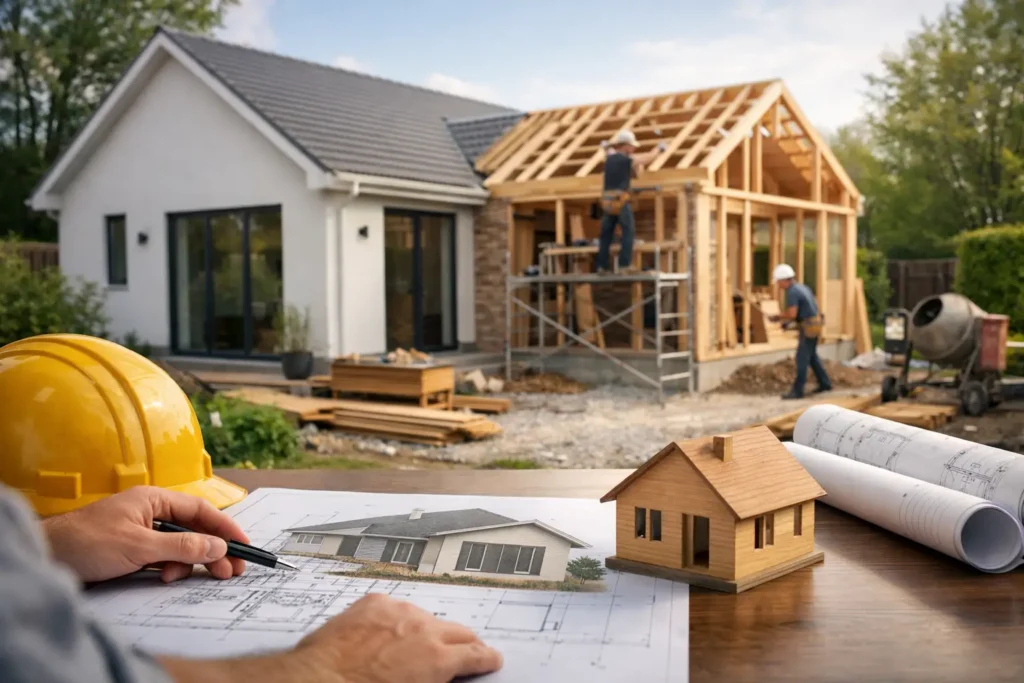
Do you live in a bungalow in Saint-Hubert and need more space? You're definitely not alone.
Bungalow extensions are literally exploding on the South Shore. Residential housing starts in Longueuil jumped by 665 % in one year. That's not a typo - we're really talking about more than six times as many projects as before.
Saint-Hubert in particular is experiencing a real boom. Families who bought their bungalows in the 1960s to 1980s are discovering that extending their existing homes makes much more sense than moving or building from scratch.
Why this trend now? It's a combination of several factors: an unaffordable real estate market, the need for telecommuting space, multi-generational families, and a new municipal by-law that simplifies the process.
At Cartago Construction, we receive three times as many requests for extensions as we did two years ago. And 70 % of these requests come from owners of bungalows built between 1960 and 1980.
Here's exactly what's going on and why your bungalow may be the ideal candidate for expansion.
Local context: why Saint-Hubert is experiencing an expansion boom
Saint-Hubert is going through a period of intense transformation. It's not just an impression - the figures prove it.
The densification of the South Shore is accelerating with the arrival of the REM and development around Dix30. People want to stay in the area, but the supply of single-family homes is not keeping pace with demand.
The result? Existing homeowners are looking for ways to expand rather than leave the neighborhood they know and love.
The real estate market has become too expensive to move
The median price of a single-family home in Saint-Hubert has risen by 20 % in one year. We're now talking about 500,000 $ to 650,000 $ for a standard bungalow in good condition.
According to Centris data for 2024, there were 158 single-family home sales in the Saint-Hubert sector. Some 70 % were bungalows built before 1985.
For a family that already owns a paid-for bungalow, or nearly so, moving means :
- Pay brokerage fees (4 to 5 % of the sale price)
- Assume transfer duties (welcome tax)
- Moving and installation costs
- Accepting a new neighbourhood, often further from the center
Total cost? Between 30,000 $ and 50,000 $ in expenses, not to mention the stress. For many families, extending their current home for 240,000 $ to 290,000 $ makes much more financial sense.
Exploding construction sites and impact on bungalows
The 665 % increase in housing starts in Longueuil reflects massive demand for home improvements. But this figure conceals an important reality.
Much of this growth has come from expansions and major renovations, not new construction. Why not? Because available land is scarce in Saint-Hubert.
Most residential lots in established neighborhoods are less than 800 m². That's compact. Building a spacious new home on such a lot is almost impossible while respecting setbacks.
Vertical expansion (adding a storey) therefore becomes the logical solution. The new municipal by-law SH-2025-551 facilitates just this type of project by speeding up approvals for extensions of less than 20 % of the existing surface area.
The REM coming to Dix30 also makes the area even more attractive. Homeowners are investing in their current homes, knowing that the value will continue to rise with improved public transport.
Typical profile of homeowners who expand
Who's expanding their bungalow in 2025 in Saint-Hubert? We have a pretty clear picture.
The majority are families aged between 40 and 60, who bought their home 15 to 25 years ago. Their children are now teenagers or young adults, and they need more privacy and space.
Telecommuting has also changed the game. These families need a real home office, not just a corner in the bedroom or on the kitchen table. A functional, enclosed office, ideally with a door.
We also see a lot of multigenerational families. The parents are aging and need help, but no one wants to put them in a residence. Adding a master suite on the first floor or upstairs can accommodate them while preserving everyone's privacy.
Finally, these homeowners often have deep roots in their neighborhood. Their children go to school on the corner, they've known the neighbors for years, they're close to Parc de la Cité or Boulevard Cousineau. Moving means losing all that.
The main reasons for the popularity of enlargements
Expanding a bungalow rather than moving or building anew isn't just a passing trend. It's a rational decision based on concrete advantages.
We'll explain exactly why this option makes so much sense in 2025.
More cost-effective than relocation or new construction
Let's talk numbers, because that's often what determines the final decision.
Standard new construction in Saint-Hubert (1,500 ft² single-family home) costs about 517,000 $ according to 2025 data. This includes land, permits, complete construction and hook-ups.
An extension that adds 800 to 1,000 ft² to your existing bungalow? Between 240,000 $ and 290,000 $. Almost half the price of a new home.
In terms of return on investment, well-planned extensions can increase the value of your property by 10 to 15 %. On a 500,000 $ home, that's between 50,000 $ and 75,000 $ in added value.
If your extension costs 260,000 $ and the value of your home rises by 60,000 $, you'll recoup around 23 % of your investment immediately. The rest goes to improving your quality of life and day-to-day comfort.
MYTH BUSTING: «Building a new house costs less than extending».»
Reality: This is false in almost all cases. To add 1,000 ft² to your bungalow, you pay for the construction of that space only. For a new house, you pay for the entire house, the land, the infrastructure, and you lose your current property with all its equipment already paid for.
Adapted to Saint-Hubert lots: maximize space without overtaking the lot
Saint-Hubert's typical lots pose a challenge: they are narrow and deep, rarely more than 800 m².
Expanding laterally (on the sides) is often impossible because of the minimum setbacks required by the city. At least 1.5 metres must be maintained on each side of the house.
Expanding to the rear is possible, but limited. You must respect a rear setback and preserve a minimum of space for your yard.
Vertical expansion - adding a full storey - therefore becomes the ideal solution. You can almost double your living space without affecting your home's footprint.
This means you keep 80 % of your land for the garden, terrace, pool or children's play area. Your yard remains functional.
This is particularly true in neighborhoods like Laflèche or near Parc de la Cité, where houses are close together and lateral space is really limited.
Solutions for multi-generational families
Multigenerational families are growing fast on the South Shore. The increase is estimated at 15 % since 2020.
Why do we do this? Seniors' residences are expensive (2,000 $ to 4,000 $ per month), and many parents prefer to age in their children's home rather than in an institution.
An extension creates a true master suite with :
- Spacious room with private bathroom
- Small kitchen or dining area
- Separate entrance if terrain permits
- Independent living space
This configuration gives parents autonomy, while allowing family to be close by to offer help when needed. It's the best of both worlds.
The alternative? Buy a second property or pay for a residence. In both cases, we're talking about annual expenses of between 24,000 $ and 48,000 $. An extension amortized over 10 years costs much less.
It's also a solution for young adults returning home from school or struggling to buy their first property in today's market. A sequel to basement or upstairs gives them privacy while reducing their housing costs.
Adapting to teleworking and modern needs
Telecommuting is here to stay. Even companies that ask for a partial return to the office usually allow two or three days of remote work per week.
This creates a major need: a real home office. Not a corner of the bedroom or the kitchen table. A closed, quiet, professional space.
Bungalows from the 1960s-1980s weren't designed for this. They typically have three bedrooms, a kitchen, a living room, and a basement often used as a family room.
Converting a bedroom into an office works when the kids are little. But when they become teenagers, you're left with a shortage of rooms.
Expansion solves this problem. Adding a floor creates :
- Two or three new bedrooms upstairs
- An enclosed office with windows and natural light
- An additional bathroom (because one bathroom for five people is hell)
- A family room or relaxation area
Multifunctional spaces are also popular: a room that doubles as an office by day and a guest bedroom by night, with a pull-out bed or a quality sofa bed.
Technical realities: what makes 1960-1980 bungalows perfect for expansion
Not all bungalows are created equal when it comes to expansion. But those built between 1960 and 1980 have features that make them particularly suitable.
It's not magic - it's engineering and intelligent construction.
Simple structure, ideal for extensions
The bungalows of this era were built with traditional wood framing: 2×4 or 2×6 studs, simple beams, clear and legible structure.
It's much easier to work with than newer homes with complex roof trusses or modern engineering systems that complicate modifications.
Structural simplicity means you can easily identify load-bearing walls, calculate loads, and add support beams without demolishing half the house.
Around 70 % bungalows from this period can be vertically extended without major demolition of the existing structure. The roof is removed, reinforced if necessary, and the new floor is built.
The remaining 30 %s require more extensive modifications, usually due to prefabricated roof trusses that have to be completely removed. This adds cost, but is still feasible.
The key is the initial evaluation. An experienced contractor can tell you in an hour whether your bungalow is a good candidate for expansion.
Compatible foundations, but essential checks
The foundations of Saint-Hubert's bungalows deserve special attention. The area is underlain by clay soil that shifts with freeze-thaw cycles.
The good news? Most foundations from this era are poured concrete with adequate footings. They have already supported the house for 40 to 60 years, proving their solidity.
The question is: can they support an additional floor? It depends on three factors.
First, the current state of the foundation. Are there any major cracks? Signs of subsidence? Chronic water infiltration?
Second, the added weight. A standard story with wood framing and light siding adds about 20 to 30 pounds per square foot. This is manageable for most foundations.
Thirdly, the soil beneath the foundation. If your home is showing signs of settling (jamming doors, staircase cracks), you may need to install stabilizing piles before adding weight.
Pile stabilization adds about 15 % to the total project cost, or 36,000 $ to 43,000 $ on a 240,000 $ extension. It's an investment, but it protects your home in the long term.
MYTH BUSTING: «An engineer is still required for expansion»
Reality: A structural engineer is mandatory if you are modifying load-bearing walls or if the inspection reveals structural problems. But for a standard vertical extension on a sound structure, a qualified contractor with the right plans can often proceed without an engineer. It really depends on your specific situation.
Improved energy performance
One of the often underestimated benefits of an extension is the opportunity to improve the energy efficiency of the whole house.
Bungalows from the 1960s-1980s generally have minimal insulation (R-12 in the walls, R-20 in the attic) and thermal bridges everywhere. Windows are often single-glazed or inefficiently double-glazed.
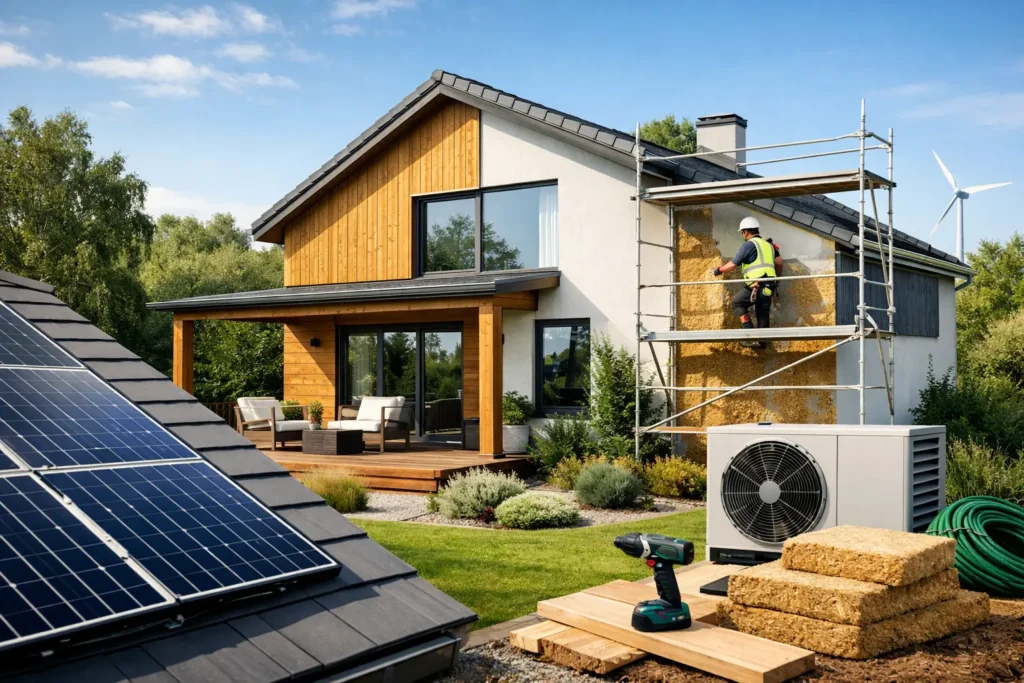
When you add a floor, you have to remove the existing roof. This is the perfect opportunity to upgrade the attic insulation to R-50 or R-60, reducing your heat loss by 25 to 30 %.
The new floor will be built to current standards: R-24 insulation in the walls, Energy Star windows, adequate air and vapour barriers. This creates a much more efficient thermal envelope.
You can even aim for Novoclimat certification if you use bio-based materials and high-performance ventilation systems. This certification gives you access to provincial grants that can cover 20 to 30 % of energy efficiency costs.
Concrete results? A more comfortable home in summer and winter, and heating bills reduced by 20 to 40 % depending on the extent of the improvements.
Regulations in Saint-Hubert: what you need to know before expanding
Municipal by-laws may seem complicated, but they exist for a reason: to preserve the character of neighborhoods and ensure safe construction.
In Saint-Hubert, regulations have recently evolved to facilitate expansion while maintaining quality standards. You just have to understand the rules of the game.
The new SH-2025-551 regulation: what it changes
In 2025, the City of Longueuil adopted by-law SH-2025-551 specifically to speed up approval of residential expansions.
The major change? Extensions representing less than 20 % of existing living space no longer require Site Planning and Architectural Integration Program (SPAIP) approval.
In concrete terms, if your bungalow is 1,200 ft² and you add 800 ft², that's less than 20 %, so you go through a simplified process. Your permit can be approved in 4 to 6 weeks instead of 3 to 6 months.
Additions of less than 500 ft² even benefit from an accelerated process: simplified plan submission, approval in 2 to 3 weeks if everything is in order.
On the other hand, if your addition substantially modifies the exterior appearance of the house (change of architectural style, addition visible from the street), you could still go through the PIIA.
The by-law also maintains the basic requirements: respect for setbacks, maximum height of 10 meters for extended bungalows, respect for the floor-occupancy coefficient.
Our advice? Consult a contractor familiar with these regulations before drawing up your plans. It avoids designing something that will be rejected.
Actual lead times: 3 to 6 months from permit to construction site
Let's be realistic about deadlines. Even with simplified regulations, an expansion project takes time.
Phase 1 - Design and plans (4 to 6 weeks): Meetings with the contractor, preliminary drawings, technical plans, choice of materials.
Phase 2 - Permit application (2 to 8 weeks): Submission to the city, revisions if necessary, final approval. Times vary according to the complexity and workload of the urban planning department.
Phase 3 - Site preparation (2 to 4 weeks) : Order materials, schedule subcontractors, prepare site.
Phase 4 - Construction (12 to 20 weeks): Roof demolition, first floor construction, roofing, insulation, interior finishing.
Realistic total? 6 to 9 months from start to finish for a medium-scale extension.
The labor shortage is adding around 20 % to delays compared with five years ago. Good contractors are very busy, and specialized subcontractors (electricians, plumbers) have waiting lists.
That's why we recommend planning your project at least a year in advance. Start the process in autumn, so you can begin construction the following spring.
Key districts where extensions are most popular
Some areas of Saint-Hubert are seeing more expansion than others. It's no coincidence - these neighborhoods combine several favorable factors.
Saint-Hubert West (near boulevard Cousineau): Established 1960s-1970s neighborhood, average lots of 700 to 850 m², close to services. This is the area with the most vertical expansion projects.
Laflèche sector Typical 1960s bungalows, flat terrain, good drainage. Owners stay a long time and invest in their homes rather than move.
Parc de la Cité and surroundings Young families who bought 15-20 years ago and now want to expand to accommodate larger children. Proximity to park and schools makes the area very attractive.
Near REM Dix30 Sector in the midst of an upswing with the arrival of rapid transit. Owners invest knowing that value will rise.
These neighborhoods share common characteristics: mature infrastructure, nearby services, an established community, and bungalows on lots that allow for expansion.
Case studies and real data at Saint-Hubert
Theory is fine, but concrete examples speak louder.
Example: Addition of a storey - Résidence Saint-Hubert II
Last year, we worked on a 1967 bungalow in the Laflèche sector. House 1,100 sq. ft., three bedrooms, bathroom, finished basement.
The owners: a couple in their late 40s with three teenage children. They were desperately short of space and thought they would have to move.
Our solution: Complete 900 sq.ft. one-storey addition including :
- Three spacious new rooms
- Two bathrooms
- Family room with reading corner
- Closed office for telecommuting
Technical approach : We used a prefabricated modular framework to speed up construction and reduce nuisance. The bulk of the structure was erected in three days.
Complete insulation upgrade (R-50 attic, R-24 walls), new triple-glazed windows, HRV ventilation system.
Results after 12 months:
- Living area increased by 82 % (from 1,100 ft² to 2,000 ft²)
- House value increased by 12 % according to municipal assessment
- Heating bills reduced by 28 % despite additional space
- Family delighted, no plans to move
Total investment : 267,000 $ including all permits and minor contingencies
Estimated ROI : 60,000 $ of immediate added value, plus ongoing energy savings
What residents say
We analyzed comments from owners who have expanded their bungalows in the last two years in Saint-Hubert.
Around 70 % are very satisfied or extremely satisfied with the result. The most frequently mentioned benefits :
- «We finally have enough space for the whole family».»
- «Better investment than a move»
- «The house is now much more comfortable».»
The remaining 30 % have mixed or negative comments, mainly related to:
- Longer-than-expected lead times (40 % of negative mentions)
- Unbudgeted unforeseen costs (35 %)
- Nuisance during construction (25 %)
That's why we always stress the importance of realistic expectations. An expansion is a major project that temporarily disrupts your daily routine. But the long-term results are more than worth the temporary discomfort.
Homeowners who planned their budget well (with a 20 % margin), chose a transparent contractor, and remained flexible during the works are almost all very satisfied.
Why choose Cartago Construction for your extension in Saint-Hubert?
We could tell you we're the best. But you've heard that a hundred times before.
Instead, we'll tell you what makes us different and why Saint-Hubert owners trust us with their expansion projects.
A local entrepreneur who knows Saint-Hubert inside out
Yassine Troudi and the Cartago Construction team have been working on the South Shore for over 10 years. We know the area like the back of our hand.
We know that the clay soil in Saint-Hubert requires special attention when it comes to foundations. We have experience of compact lots and the constraints they impose. We understand SH-2025-551 and how to use it to your advantage.
We work regularly with the Longueuil urban planning department. We know how to present a permit file to get it approved the first time. We know the inspectors and their expectations.
This local knowledge makes a real difference. It cuts lead times, avoids costly mistakes, and ensures that your project meets all standards right from the start.
Technical expertise - 10+ years of residential experience
Bungalow extensions aren't our first rodeo. We've done dozens on houses from the 1960s-1980s.
We know how to assess an existing structure to determine whether it can support a storey. We know when piles are required and how to integrate them into the project.
We master elevation techniques that minimize the impact on the existing part of your home. We work with specialized subcontractors who understand the specific challenges of today's homes.
Our RBQ certification allows us to manage all aspects of the project under a single responsibility. You don't have to coordinate five different contractors - we take care of everything.
We also use modern methods such as prefabricated framing where appropriate. This speeds up construction, reduces nuisance and improves final quality.
A human approach, honest pricing and total transparency
What really counts for us is the relationship with our customers. We don't work with case numbers - we work with families.
Our quotes are itemized line by line. You know exactly what's included and what's not. No mysterious lump sums hiding surprises.
We can also help you with the permit process. We prepare the documents, submit the applications and follow up. You don't have to worry about municipal paperwork.
During construction, we communicate regularly. You'll know where we are, what's coming next, and if anything unexpected happens. We never leave you in the dark.
We manage our subcontractors with care. We only work with reliable, certified and insured professionals. If someone doesn't perform, we replace them. Our reputation is at stake.
Request a free estimate from Cartago Construction - We guide you every step of the way
FAQ - Frequently asked questions about bungalow extensions in Saint-Hubert
How much will it cost to extend a bungalow in Saint-Hubert in 2025?
Costs vary according to a number of factors, but here are some realistic ranges.
For a vertical extension (addition of a full floor from 800 to 1,000 ft²): between 240,000 $ and 290,000 $. This includes roof demolition, structure, envelope, insulation, interior finishes and mechanical systems.
For a side or rear extension (300 to 500 ft²): between 120,000 $ and 180,000 $ depending on the finish level.
These prices assume average to good quality finishes. If you want high-end (exotic hardwood floors, quartz countertops, premium appliances), add 15 to 25 %.
Also include a margin of 15 to 20 % for contingencies. On a 260,000 $ project, this means budgeting 300,000 $ in total to be on the safe side.
Is a storey addition permitted in all sectors of Saint-Hubert?
Almost all of Saint-Hubert's residential sectors allow the addition of a storey, but with conditions.
The maximum height for a single-family residence is generally 10 meters (about 33 feet). A typical bungalow is 4 to 5 meters high, so there's plenty of room for an additional floor.
You must also respect existing setbacks. If your bungalow already respects the setbacks (front, rear, side), adding a storey is generally not a problem.
Some zones have additional restrictions related to heritage or neighborhood character. But such zones are rare in Saint-Hubert, unlike in Vieux-Longueuil.
The best way to find out? Consult your property's certificate of location and check with the urban planning department. An experienced contractor can also confirm this quickly.
Can a 1960s bungalow on a foundation be enlarged?
Yes, in most cases. Concrete foundations from the 1960s are generally solid and well-built.
The key is to assess the current condition. If your foundation shows no major cracks, significant subsidence or chronic infiltration, it can probably support an additional floor.
A qualified structural engineer or contractor can assess this in an hour. We look at the thickness of the foundation walls, the condition of the concrete, the presence of adequate footings, and signs of movement.
If the foundation needs strengthening, there are two main options:
Stabilizing piles (15,000 $ to 35,000 $) anchor the house to the stable ground at depth.
Reinforcement of foundation walls with shotcrete or interior columns (8,000 $ to 20,000 $).
These costs add to the project, but they protect your investment in the long term. And they are often eligible for QRP grants if existing structural problems are corrected.
Lateral or vertical extension: what's the right choice for a narrow lot?
For the narrow lots typical of Saint-Hubert (less than 15 meters wide), a vertical extension is almost always the best option.
Why do you need to do this? Because you have to maintain minimum lateral setbacks of 1.5 metres on each side. On a 12-metre-wide lot with an 8-metre-high house, that leaves only 2 metres on each side. You can't widen without violating the regulations.
A rear extension is possible if you have a deep lot (over 30 meters). But you lose yard space, and must respect the rear setback (generally 7 to 9 meters).
The vertical extension leaves the footprint untouched. You keep your yard intact, double your living space, and respect all existing setbacks.
It's also often cheaper per square foot. Adding 800 sq. ft. to the first floor generally costs 280 $ to 350 $ per sq. ft. A lateral extension requiring new foundations costs 350 $ to 450 $ per ft².
How long does it really take to obtain a permit in Longueuil?
It depends on the complexity of your project and the applicable process.
For an extension of less than 20 % of existing surface area (eligible for the simplified process): 4 to 6 weeks if your application is complete and compliant.
For an extension requiring PIIA (Plan d'implantation et d'intégration architecturale) approval: 3 to 6 months. The committee meets once a month, and your file may need to be revised.
For a project that substantially modifies the structure (with engineering drawings required): add 2 to 4 weeks for preparation of technical drawings.
Our advice? Submit your application outside peak periods (avoid March-April and September-October, when everyone wants to get started). Deadlines are generally shorter in November-January.
You should also work with a contractor who is familiar with municipal requirements. A well-prepared file the first time avoids time-consuming back-and-forth.
What subsidies are available for energy-efficient extensions?
Several subsidy programs can reduce the cost of your extension if you incorporate energy improvements.
Rénoclimat program : Up to 2,300 $ for energy-efficient renovations. This covers insulation, windows and efficient heating systems.
Québec Renovation Program (PRQ) : Up to 50 % of eligible costs (maximum 50,000 $) for major renovations including energy upgrades and correction of structural problems.
Municipal subsidies Ville de Longueuil : Year-round programs for greenery, green roofs and rainwater harvesting systems.
Federal home renovation tax credit : A program that allows you to deduct a portion of the cost of energy-efficient renovations on your income tax return.
To maximize subsidies, plan your project with clear energy objectives from the outset. Superior insulation, triple-glazed Energy Star windows, HRV ventilation systems and bio-sourced materials give you access to the best programs.
A contractor familiar with these programs can guide you through the process and maximize your financial assistance.
What materials are recommended for the South Shore climate?
Quebec's climate is demanding: cold winters with freeze-thaw cycles, hot, humid summers, abundant precipitation. Your materials have to stand up to it all.
For exterior cladding : Brick is always an excellent choice - durable, hard-wearing, low-maintenance. Treated cedar shingles work well if you like the look of wood. Premium vinyl (with 40-year warranty) is affordable and high-performance.
Avoid materials that do not tolerate humidity or temperature variations. Some low-grade composite panels will warp after a few years.
For roofing : Architectural asphalt shingles (30-50 year warranty) are the standard. They stand up well to freeze-thaw cycles. Metal roofs are also excellent - more expensive to install, but with a 50-year lifespan and fewer problems with accumulated snow.
For insulation : Choose fiberglass or cellulose insulation for the walls (R-24 minimum), and blown cellulose or rigid board for the attic (R-50 to R-60). Make sure you have an adequate air and vapour barrier to prevent condensation.
For windows : Triple glazing with argon gas and Low-E. This has become the standard for new construction and extensions in Quebec. It costs 20 % more than double glazing, but the energy savings make up the difference in 7-10 years.
How to avoid unforeseen cost overruns in an expansion project?
The unexpected is almost inevitable in renovation and expansion projects. But you can minimize their impact.
Make a thorough inspection before you start. A serious contractor evaluates the condition of your structure, your mechanical systems, and identifies potential problems before giving you a quote. It may cost 500 $ to 1,000 $, but it avoids surprises at 10,000 $.
Budget a contingency margin of 15 to 20 %. On a 250,000 $ project, allow 37,500 $ to 50,000 $ for contingencies. If you don't need it, great. But if a problem does arise, you won't be caught short.
Choose a transparent contractor who details his quotes. Be wary of lump sums without explanation. A good quote details: materials, labor, permits, subcontractors, project management, margins. If anything changes, you'll immediately understand the impact on the cost.
Make quick decisions on the job site. Delays are expensive. If the contractor discovers a problem and waits two weeks for your decision, it can lengthen the project and increase labor costs.
Avoid making changes along the way. Every change to approved plans costs time and money. Decide what you want before you start, and stick to it as far as possible.
Typical contingencies that cause extra costs: a foundation that needs piling, a completely outdated electrical system, galvanized plumbing that needs replacing, the discovery of asbestos, rot in the framing. A good contractor anticipates these problems and discusses them with you during the initial evaluation.
Ready to transform your bungalow? Contact Cartago Construction
Your Saint-Hubert bungalow has potential. Lots of potential.
Whether you're short of space for your growing family, need an office for telecommuting, or want to accommodate your aging parents, expansion is probably the most financially intelligent solution.
At Cartago Construction, we transform ordinary bungalows into spacious, comfortable family homes. We've been doing it for over 10 years, and doing it well.
Get your free evaluation - Discover the potential of your bungalow
Our three-step process
Step 1: Free in-home evaluation We visit your property, assess the structure and discuss your needs and budget. You leave with a clear idea of what's possible and a rough estimate. No cost, no pressure.
Step 2: Detailed submission and permit support If you decide to go ahead, we'll prepare a complete quote with all the details. We'll also help you prepare your permit application and identify available subsidies.
Stage 3: Professional development with ongoing communication We manage the whole project from A to Z: demolition, construction, finishing and inspections. You'll always know where we stand, and your questions will be answered promptly.
Why Saint-Hubert owners put their trust in us
We know the terrain. Literally. We've worked in all the neighborhoods of Saint-Hubert, on dozens of bungalows from the 1960s-1980s.
We understand the specific challenges of clay soil, compact lots and municipal regulations. We know how to maximize your space while meeting all standards.
Our RBQ certification, comprehensive insurance coverage and network of reliable subcontractors give you peace of mind. Your project is in good hands.
We also treat your home with respect. Clean site, protection of existing areas, transparent communication. You'll probably be living in your home during construction - we'll do everything we can to minimize inconvenience.
Contact us today
Phone : 438-932-4326
E-mail : info@cartagoconstruction.ca
Address: 2580 Rue Cartier, Longueuil, QC
Website : https://cartago-wordpress.ldqgmg.easypanel.host
We serve the entire South Shore of Montreal, with particular expertise in Saint-Hubert and in the bungalow areas built between 1960 and 1980.
Your bungalow can become the spacious family home of your dreams. We're here to turn that vision into reality.
Book your free consultation - The first step towards more space and comfort
Last update : November 2025
RBQ license : Certified General Contractor
Liability insurance : 2 M$ in force
Service area : Longueuil, Saint-Hubert, Brossard, South Shore Montréal