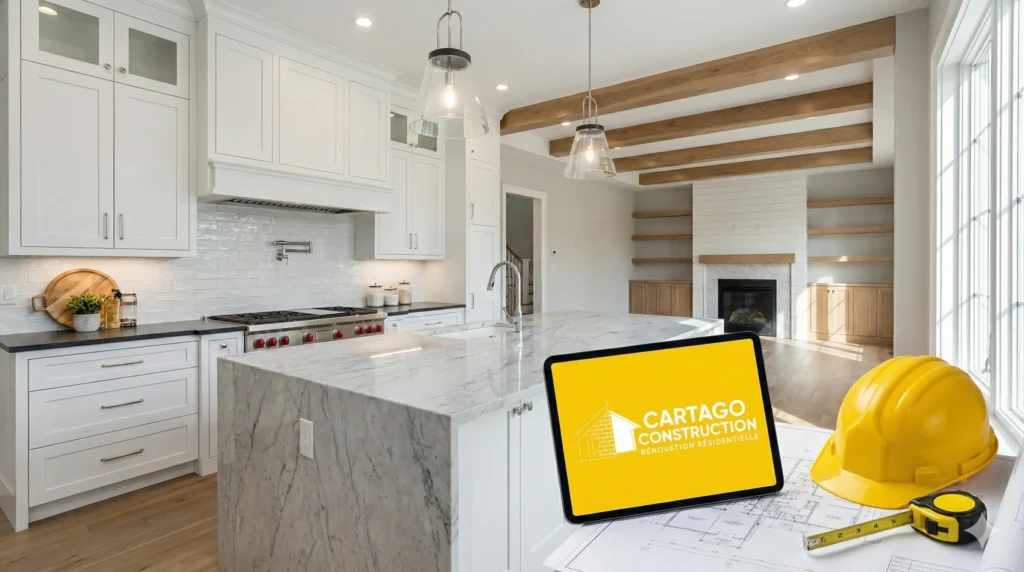
Do you dream of a home that truly reflects you? A home designed exactly to your needs, lifestyle and budget?
That's exactly what a custom home offers. Unlike development homes, where you choose from three or four standard models, a custom home is unique. It's designed for you, built for you, with your choice of materials and finishes.
On the South Shore, more and more families are opting for custom construction rather than buying an existing property. The reasons? Total control over the end result, perfect adaptation to the site, and the ability to integrate all modern energy-efficiency features right from the start.
At Cartago Construction, we've been supporting custom home projects for over 10 years. We know every step of the process, the pitfalls to avoid, and how to deliver exactly what we promise.
Here's how it really works, from the first idea to the handover of the keys.
What is a custom home in Quebec?
A custom home is a residence designed and built specifically to meet your needs. Not a pre-existing model slightly adapted to your needs - a completely customized project.
That means you're actively involved in all the important decisions: room layout, space size, orientation of the house on the lot, exterior and interior materials, mechanical systems, and finishes.
What's the difference with a prefabricated house or a development model? In these cases, the design is already done. You may choose the color of the cabinets or the type of flooring, but the structure, layout and architecture are fixed.
With a custom-built home, you start with a blank sheet of paper. Want an enclosed office on the first floor for telecommuting? We plan it. Want a large kitchen open to the living room for family gatherings? We design it. Need a master suite on the first floor to accommodate your aging parents? We'll integrate it right from the start.
More and more families in Longueuil are choosing this option. Why? Because with real estate prices up 20 % in just a few years, building exactly what you need makes more sense than buying an existing home that requires 80,000 $ of renovations to make it fit.
Discover how Cartago supports unique projects - Free consultation
The advantages of a custom home in Longueuil
Custom building isn't just about personalization. It's also a smart financial and practical decision.
Perfectly adapted to Quebec's climate
A custom-built home lets you integrate the features that make a home comfortable and economical in Quebec right from the start.
Superior insulation (R-60 in the attic, R-24 in the walls) that far exceeds minimum standards. It costs 5,000 $ to 8,000 $ more to build, but you save 1,500 $ to 2,500 $ per year in heating and cooling costs.
Central heat pump integrated from the outset. It heats in winter and cools in summer with far greater efficiency than conventional systems. A properly sized heat pump can reduce your energy costs by 30 to 40 %.
Triple glazing on all windows. This is now standard for quality new construction in Quebec. It eliminates condensation in winter and considerably reduces heat loss.
HRV ventilation system (heat recovery air exchanger) that maintains healthy air while recovering 75 to 90 % of the heat that would normally be lost.
These elements are much more expensive and complicated to add after construction. Integrating them from the outset is the most logical approach.
Land optimization
Available lots in Longueuil and on the South Shore are rarely perfect. They are often narrow, irregular or sloping.
A custom-built home can be designed to maximize the use of these challenging terrains. Got a sloping lot? We design a home with a walk-out basement that turns the slope into an advantage. Do you have a narrow lot? We optimize width and build high.
In Vieux-Longueuil or certain sectors of Saint-Hubert, compact lots require intelligent planning. A custom-built home makes the most of every available square meter without waste.
The orientation of the house on the plot is also optimized. Large windows face south to maximize passive solar gain in winter. Bedrooms face east to take advantage of morning light. Windows are limited to the north to reduce heat loss.
These design decisions make a huge difference to everyday comfort and energy costs, but they can only be made with a bespoke design.
Complete control over budget and choices
With a custom home, you decide exactly where every dollar goes.
Would you rather invest in a high-end kitchen but have simpler rooms? The choice is yours. Want hardwood floors throughout but laminate countertops to save money? We've got you covered.
This flexibility allows us to adapt the project to your actual budget. If costs rise too high, we work together to identify where we can cut back without compromising overall quality.
You also avoid paying for features you don't want. Development homes often include standard features that some buyers don't want but pay for anyway.
Guaranteed compliance with RBQ and municipal standards
All New construction in Quebec must comply with the Quebec Construction Code and municipal regulations. A custom home built by an RBQ-certified contractor guarantees this compliance from the start.
At Cartago Construction, we manage all regulatory steps: zoning verification, preparation of compliant plans, permit application, coordination of municipal inspections. You don't have to navigate this bureaucracy alone.
All systems are installed according to standards: electricity according to the Canadian Electrical Code, plumbing according to the National Plumbing Code, engineer-approved structure if required.
This compliance protects you. It ensures that your investment is safe, insurable, and will resell easily the day you decide to sell.
Schedule a free consultation with Cartago Construction - We'll guide you every step of the way
What are the steps involved in building a custom home in Longueuil?
Building a custom home isn't a mysterious process. It follows logical, predictable steps. Here's exactly how it works.
Step 1: Needs analysis and preliminary study
It all starts with an in-depth conversation about your needs, lifestyle and priorities.
We explore questions like: How many people will be living in the house? Do you need an office for telecommuting? Do you often have family over? Could your elderly parents move in with you in a few years' time? Do you have hobbies that require specific spaces (workshop, music room, gym)?
We also discuss your realistic budget. Not the unlimited dream budget, but what you can really invest. This includes the cost of the land if you don't already have one, the construction itself, permit fees, municipal hook-ups, and a contingency margin.
If you already own a lot, we visit it. We assess its characteristics: size, slope, orientation, access to municipal services, zoning constraints. If you're still looking for a lot, we'll guide you on what to look for.
This first step usually takes 1 or 2 meetings, and helps determine whether the project is realistic and in what order to proceed.
Step 2: Architectural plans and custom design
Once your requirements have been defined, we move on to design.
We work with Quebec architects or architectural technologists who understand local standards and climate. They draw up plans according to your specifications: room layout, circulation, dimensions, ceiling heights, window orientation.
Plans automatically comply with Ville de Longueuil bylaws: setbacks (minimum distance between house and lot lines), maximum height, floor area ratio, parking requirements.
We also take neighborhood considerations into account. If your home is surrounded by bungalows, we don't propose a three-storey monster that would stand out. The design harmonizes with the area while remaining unique.
3D renderings let you visualize your home before it's built. You see exactly what it will look like from the outside and how the interior spaces fit together. If you don't like something, we adjust it now, not during construction when changes are expensive.
This design phase takes 3 to 6 weeks, depending on the complexity of the project.
Step 3: Obtaining building permits in Longueuil
Finalized plans are submitted to the Ville de Longueuil for approval and building permit.
The typical process in Longueuil takes 6 to 10 weeks. The city verifies that everything complies with the Quebec Construction Code, municipal zoning by-laws and urban planning standards.
Required documents include :
- Complete architectural plans (elevations, sections, floor plans)
- Technical drawings (structural, electrical, plumbing, mechanical)
- Certificate of lot location
- Completed permit application forms
- Payment of permit fees (typically 1,000 $ to 3,000 $ depending on project value)
If your lot is in a zone with a Site Planning and Architectural Integration Program (SPAIP), add 2 to 4 weeks for aesthetic approval.
At Cartago, we manage the entire process. We prepare the documents, submit the application, follow up with municipal officials, and keep you informed of progress.
Stage 4: Construction and site management
Once the permit has been obtained, construction begins. This is when your home physically takes shape.
- Excavation and foundations (2 to 3 weeks) : The basement is excavated, and the concrete footings and foundation walls are poured. If the soil is clay (common in Longueuil), stabilization piles are installed if recommended by the geotechnical assessment.
- Frame and structure (4 to 6 weeks) : The walls, floors and roof structure have all gone up. It's impressive to see the house take shape in just a few weeks.
- Outer cover (3 to 4 weeks) : Exterior cladding, windows, doors, roof. The house becomes weatherproof.
- Mechanical systems (4 to 5 weeks) : Plumbing, electrical, heating, ventilation, air conditioning. All systems are installed by certified and inspected subcontractors.
- Insulation and interior finishing (6 to 8 weeks) : Insulation, vapor barrier, drywall, paint, floors, cabinets, countertops. All the details that turn a structure into a comfortable home.
Throughout construction, we coordinate qualified subcontractors. Our network of professionals on the South Shore ensures that every trade does its job to the highest standards.
Mandatory RBQ and municipal inspections are scheduled at the appropriate times: foundations, framing, electricity, plumbing, insulation, final. Nothing goes ahead without the inspector's approval.
Stage 5: Interior and exterior finishing
The final weeks are devoted to the details that make all the difference.
You choose paint colors, light fixtures, door handles and faucets. All those little elements that really personalize your home.
The final quality check goes through each room with a fine-tooth comb. We check that everything works: every light, every socket, every tap, every door and window. Where necessary, adjustments are made.
The basic landscaping is completed: final grading, sod or sod, driveway. The house is ready to move into.
Project delivery includes a full walk-through with you. We explain how all the systems work, and provide you with equipment manuals, warranties, and all compliance documents.
Total process time: 12 to 18 months from the first meeting to the handover of the keys.
Talk to Yassine for full, transparent support from planning to delivery
How much does a custom home in Longueuil cost?
The question of cost always comes up. And so it should - it's probably your biggest investment.
There's no single price for a custom home. It depends on too many variables. But we can give you realistic ranges for 2025.
For a medium-sized custom-built single-family home (1,500 to 2,000 sq. ft.) with standard to good quality finishes, expect to pay between 260 $ and 350 $ per square foot, all inclusive.
It means:
- 1,500 ft²: 390,000 $ to 525,000 $
- 1,800 ft²: 468,000 $ to 630,000 $
- 2,000 ft²: 520,000 $ to 700,000 $
These amounts include the complete construction, but not necessarily the land. If you need to buy land, add 100,000 $ to 250,000 $ depending on your location in Longueuil or on the South Shore.
Variables affecting cost :
- Area : Bigger costs more, of course. But the cost per square foot drops slightly for larger homes.
- Materials : Brick vs vinyl, hardwood vs laminate, quartz vs granite vs laminate countertops. Each choice impacts the final cost.
- Architectural complexity : A simple rectangular house costs less than one with multiple offsets, complex roofs and elaborate architectural features.
- Terrain : A flat plot with easy access costs less to develop than a sloping plot with difficult soil.
- Finish level : Standard, good, or high-end. The difference can be from 50 $ to 100 $ per square foot.
The importance of a detailed, transparent quote? You need to know exactly what's included and what's not. At Cartago, our quotes detail every item: foundation, structure, envelope, mechanical systems, interior finishes, exterior finishes.
We also recommend adding a buffer of 10 to 15 % for contingencies. On a 500,000 $ project, budget 550,000 $ to 575,000 $. If you don't use all the margin, fine. But if something unexpected happens, you're not caught unprepared.
Receive a free, detailed estimate - We analyze your project free of charge
What mistakes to avoid when building a custom home?
There are certain mistakes that come up time and again, and cost a lot of money. Here's how to avoid them.
Error #1: Choosing a contractor without an RBQ license
In Quebec, any contractor doing work of more than 5,000 $ must have an RBQ license. It's not just a formality - it's your protection.
A contractor without an RBQ license cannot legally obtain a permit. You have no recourse if the work is poorly done. You're not covered by the mandatory warranty on hidden defects. Your home insurance may refuse to cover damage caused by non-conforming work.
Always check your contractor's RBQ license on the Régie website before signing anything.
Error #2: Underestimating land costs
The purchase price of the land is just the beginning. You also need to budget for :
- Certificate of location (1,500 $ to 3,000 $)
- Geotechnical soil assessment (2,500 $ to 4,000 $)
- Connections to municipal services (water, sewerage, electricity): 5,000 $ to 15,000 $ depending on distance
- Levelling and drainage (3,000 $ to 8,000 $)
- Transfer taxes (welcome tax): 1 to 2 % of the price
A plot of land bought for 150,000 $ can easily cost 170,000 $ to 180,000 $ once all these costs have been added.
Error #3: Ignore municipal zoning
Not all plots of land are suitable for all types of construction. Before buying a plot of land, check :
- Type of zoning (single-family residential, multi-family, mixed)
- Setbacks (minimum distances between the house and lot lines)
- Maximum permitted height
- Land-use coefficient (percentage of land that can be built on)
- Restrictions on exterior appearance (heritage zones)
Buying a plot of land and then discovering that you can't build what you wanted is an avoidable disaster.
Error #4: Incorrect space planning
Design your home for your real-life Quebec lifestyle, not for California decorating magazines.
Do you really need a separate formal dining room? Most Quebec families eat in the kitchen or in an open space. Use this space differently.
Is your entrance vestibule big enough for winter coats, boots and bags? A tiny vestibule quickly becomes a nightmare in winter.
Can your garage really accommodate two cars AND all your gardening equipment, tools and bicycles? Many garages are too small and end up being used only as sheds.
Error #5: Neglecting continuous quality control
Construction errors are easier and cheaper to correct during construction than afterwards.
Visit your site regularly. Ask questions. If something seems odd, ask for explanations.
A good contractor encourages your visits and answers your questions openly. A contractor who discourages you from visiting the job site is probably hiding something.
Why trust Cartago Construction with your custom-built home?
Building a custom home is an adventure that requires a partner you can trust. Not someone who just wants to sell you a project, but someone who will truly accompany you from start to finish.
10+ years of expertise and a human approach
Yassine Troudi, founder of Cartago Construction, has been working in Quebec residential construction for over 10 years. He has managed dozens of new construction and major renovation projects on the South Shore.
This experience makes a difference. We anticipate problems before they become costly. We know reliable subcontractors. We know how to navigate municipal processes. We understand the Quebec climate and how to build to last.
Our approach remains human and accessible. When you call Cartago, it's Yassine or a direct member of the team who answers. Not a receptionist taking messages.
We communicate constantly. You receive regular updates with photos. You always know where we are and what's coming next.
Transparent, comprehensive management
Our RBQ general contractor's license allows us to manage all aspects of your project under a single responsibility.
We coordinate :
- Architects or technologists
- Engineers if required (structural, geotechnical)
- Permit applications
- All subcontractors (excavation, foundations, framing, electrical, plumbing, finishing)
- Municipal inspections
- Final delivery
You have a single point of contact. If something goes wrong, we fix it. That's our responsibility.
Our quotes are itemized line by line. You know exactly how much each item costs. No mysterious lump sum that hides surprises.
If something unexpected comes up during the course of a project (it happens sometimes), we stop, explain the situation, present options with costs, and wait for your approval before continuing.
Network of reliable, certified subcontractors
We only work with proven professionals. Our electrician has his C license. Our plumber is certified. Our excavator has the equipment and experience. Our finishers deliver impeccable quality.
This network has been built up over 10 years of projects. We don't do business with just anyone. If a subcontractor doesn't perform, we don't call them back.
This reliability ensures that your project progresses on schedule, with the quality promised.
Comprehensive insurance and guarantees
We maintain a $2 million liability insurance policy that covers all our work sites. If an accident does happen, you and your property are protected.
All our subcontractors also have their own insurance policies. You are never exposed to a financial risk due to an accident on your worksite.
Your new home is also covered by the mandatory RBQ warranty, which protects against hidden defects for several years after construction.
Recent projects on the South Shore
We delivered custom homes in Longueuil, Saint-Lambert, Brossard and Saint-Hubert. Each project was unique, adapted to the specific terrain and particular needs of the owners.
These customers can testify to our professionalism, our respect for deadlines, and the quality of our work.
Request your free consultation - Fast, no-pressure response
FAQ : Custom homes in Longueuil
How long does it take to build a custom home?
From the start of the design phase to handover of the keys, allow between 12 and 18 months.
Typical distribution :
- Design and plans: 2 to 3 months
- Obtaining permits: 2 to 3 months
- Construction: 8 to 12 months
Factors that lengthen lead times: difficult terrain, complex design, numerous customizations, unfavorable weather, shortage of manpower.
Simple projects on flat ground can be completed in 10 to 12 months. Complex projects with technical challenges can take 18 to 24 months.
What's the budget for a complete project?
For a custom-built home complete with land, expect to pay between 550,000 $ and 850,000 $ on the South Shore in 2025.
This amount includes :
- Land: 100,000 $ to 250,000 $
- Construction: 400,000 $ to 550,000 $ (1,500 to 2,000 ft²)
- Miscellaneous costs (permits, connections, landscaping): 50,000 $ to 75,000 $
If you already own a plot of land, eliminate this item. If you want a smaller house or one with a simpler finish, you can reduce this item from 100,000 $ to 150,000 $.
Don't forget to add 10 to 15 % for contingencies.
Do I need a plot of land in Longueuil before I start?
No, but it helps to have a clear idea of what's realistic.
If you already have a plot, we can design specifically for its features. If you're still looking, we can guide you through the search and tell you which lots suit your plans.
Some customers prefer to first define exactly the home they want, then look for a suitable plot of land. Others find the perfect plot and then design the ideal home for it.
Both approaches work. The important thing is to make sure the land and plans are compatible before you buy.
What's the difference between an architect and a technologist in Quebec?
Both can draw house plans, but their training and field of expertise differ.
An architect has a complete university education (bachelor's and master's degrees) and is a member of the Ordre des architectes du Québec. He can handle complex projects, commercial buildings and elaborate architectural designs. His fees are generally higher (8 to 12 % of the construction cost).
An architectural technologist has a college education (DEC in architectural technology) and is a member of the Ordre des technologues professionnels du Québec. He is perfectly qualified to draw plans for standard residential homes of average complexity. His fees are generally more affordable (5 to 8 % of the construction cost).
For a standard custom-built single-family home, a competent technologist is all you need. For a highly complex or innovative architectural project, an architect can provide added value.
Can plans be modified during the course of a project?
Yes, but it usually costs more and can delay the project.
Modifications before construction begins are easy and inexpensive. Change what you want during the design phase.
Once construction has started, modifications become complicated. If you change the layout of a wall after the framework has been erected, you have to demolish and rebuild. If you change the location of the plumbing after the pipes have been installed, you have to do it all over again.
Minor modifications (paint color, type of light fittings, door handles) are still possible late in the project. Structural or mechanical modifications must be decided early on.
Our advice? Take the time to think through your choices during the design phase. Once you're happy with the plans, stick to them as much as possible.
What materials are recommended for Quebec's climate?
Quebec's climate is demanding: cold winters with freeze-thaw cycles, hot, humid summers. Your materials have to stand up to it all.
- Exterior cladding : Brick (lasts 100 years, zero maintenance), treated cedar shingles (beautiful, durable if maintained), high-end vinyl with 40-year warranty. Avoid cheap fiberboard, which swells with humidity.
- Roofing : Architectural asphalt shingles (30-50 year warranty), or metal roofing (lasts 50+ years, excellent for shedding snow). Avoid entry-level shingles that crack after 15 years.
- Insulation : Blown cellulose or rock wool for walls and attics. Sprayed polyurethane for basements and difficult areas. Avoid standard fiberglass, which loses its effectiveness when wet.
- Windows : Triple-glazed with argon gas and Low-E. PVC or fiberglass frames (more durable than wood in our climate). Energy Star certification required.
- Foundations : Quality concrete with full waterproofing. French perimeter drainage mandatory. Stabilizing piles if soil is clayey.
An experienced contractor in Quebec knows these materials and how to install them properly to make them last.
What RBQ standards apply to new construction?
All new construction in Quebec must comply with the Quebec Construction Code, which is based on Canadian national codes with provincial adaptations.
The main standards :
- Structure : Load resistance (snow, wind, structural weight), basic seismic design.
- Insulation : Mandatory minimums (R-40 attic, R-20 walls). Exceeding these minimums is recommended for long-term savings.
- Electricity : Canadian Electrical Code. Installation by a C-licensed master electrician. Mandatory inspection.
- Plumbing : National Plumbing Code. Installation by a certified plumber. Mandatory inspection.
- Fire safety : Interconnected smoke and carbon monoxide detectors in every room and on every floor. Adequate emergency exits.
- Energy efficiency : EnerGuide label mandatory for all new homes.
All these standards are checked by municipal inspectors at various stages. Nothing goes forward without the inspector's approval.
How does the warranty on a new home work?
In Quebec, all new homes built by an RBQ-licensed contractor are covered by the New Residential Buildings Warranty Plan.
This mandatory warranty covers :
- First year : All construction faults and defects. If something goes wrong, the contractor must correct it free of charge.
- Second and third years : Construction defects affecting the solidity of the structure (structural, waterproofing or major mechanical system problems).
- Five years : Major hidden defects affecting solidity or watertightness that were not visible at the time of delivery.
This warranty is automatic and mandatory. You don't have to pay extra for it - it's included in all legal new construction.
In addition to this mandatory warranty, many contractors offer their own additional warranties on certain elements. At Cartago, we guarantee our work beyond the legal minimum.
Can Cartago manage a turnkey project?
Absolutely. That's exactly what we do.
A turnkey project means that you entrust everything to us, from start to finish:
- Site search if necessary
- Design and plans
- Permit applications
- Management of all subcontractors
- Inspection coordination
- Final delivery
You don't have to coordinate ten different people. We manage everything under a single responsibility. One contract, one contact, one invoice.
You're involved in the important decisions (layout, materials, finishing), but we take care of all the execution and logistics.
This is the simplest and least stressful approach for most homeowners building their first custom home.
Is it possible to add an extension or garage?
Yes, anything is possible with custom design.
An attached garage (single or double) is easy to integrate right from the initial design stage. It costs less than adding one after the house has been built.
A detached garage can also be planned at the same time or added later. If you plan to add it eventually, we can prepare the lot and electrical connections now to facilitate the future addition.
Extensions can also be integrated: solarium, veranda, covered terrace, entrance porch. Anything that enhances your living space can be designed from the outset.
The advantage of planning everything together? The architecture is consistent, systems are correctly sized, and costs are optimized.
Build your dream home with Cartago Construction
A custom home isn't just a luxury for the rich. It's a smart decision for families who want exactly what they need, without compromise.
You control the design, the materials, the budget. You get a home that's perfectly suited to your Quebec lifestyle, built to the highest energy-efficiency standards, and built to last.
The process can seem daunting, but with the right partner, it becomes an exciting adventure rather than a stressful nightmare.
At Cartago Construction, we've been helping families build their custom homes for over 10 years. We know how to turn your vision into reality, on time and on budget.
Three simple steps to get started
Step 1: Free consultation
We meet to discuss your project. You tell us about your needs, your budget, your vision. We explain the process, answer all your questions, and give you a realistic idea of what's possible.
This first meeting is free and without obligation. You'll leave with a better understanding of what's involved in custom building.
Step 2: Detailed proposal
If you decide to go ahead, we prepare a complete proposal: preliminary sketches, realistic schedule, detailed cost estimate by item.
We take the time to explain everything. You understand exactly what you're buying, how much it costs, and how long it will take.
Step 3: Realizing your project
Once the contract is signed, we take care of everything. You take part in the important decisions, but we manage the entire execution.
You receive regular updates. You always know where we stand. And one day, you're handed the keys to your custom-built home, exactly as you'd imagined it.
Contact Cartago Construction today
Phone : 438-932-4326
E-mail : info@cartagoconstruction.ca
Address: 2580 Rue Cartier, Longueuil, QC
Website : https://cartagoconstruction.ca
We serve the entire South Shore of Montreal: Longueuil, Saint-Hubert, Brossard, Boucherville, Saint-Lambert, and neighboring areas of the Montérégie region.
Your custom home is waiting for you. We're here to build it with you.
Book your free consultation - The first step to your dream home
Last update : November 2025
RBQ license : Certified General Contractor
Liability insurance : 2 M$ in force
Service area : Longueuil, Saint-Hubert, Brossard, Boucherville, Saint-Lambert, Montreal South Shore, Montérégie
Specialities : Custom home building, major renovations, residential additions, turnkey project management