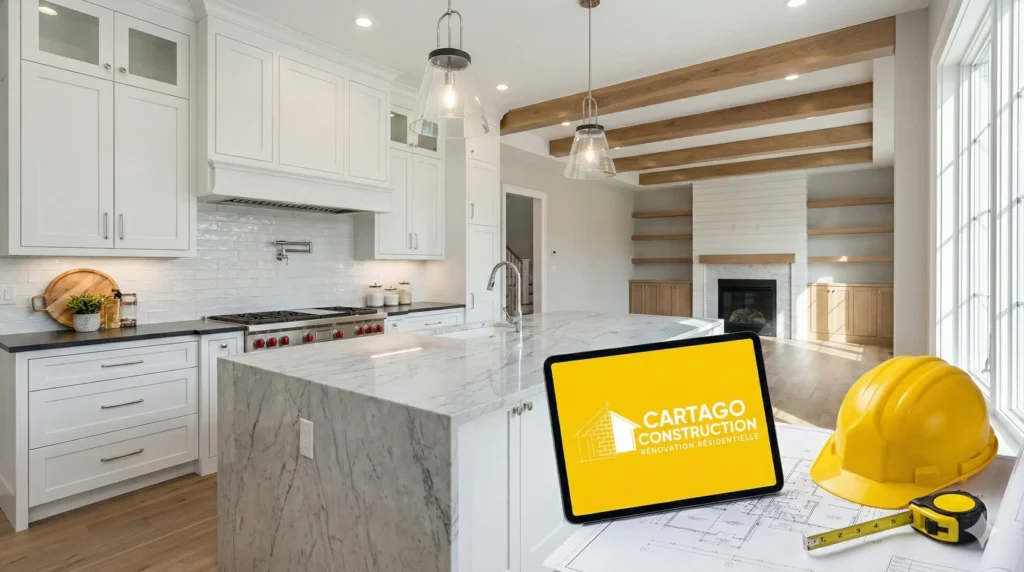
Your kitchen lacks storage, the bathroom is no longer practical or the basement has been dormant for years? A turnkey renovation lets you transform your home without having to become a site manager in the evening and on weekends. You express your needs, your tastes and your budget. A general contractor then coordinates the necessary steps to deliver a finished, functional and move-in-ready space.
For many homeowners on the South Shore of Montreal, this choice is not just about avoiding calls to subcontractors. It is a way to protect your time, keep a clear view of the project and rediscover the pleasure of living in your home.
What is a turnkey renovation?
A turnkey renovation is complete management of the work by a single point of contact. It begins with understanding your project and continues through to the finishes. Depending on the nature of the work, this may include planning, estimation, ordering materials, coordinating trades, construction work, painting, flooring and final cleaning.
The principle is simple: you don't have to separately manage the electrician, the plumber, the tile setter and the painter. Your general contractor organizes the sequence of interventions, checks the quality of the work and keeps you informed of progress.
This does not mean you lose control. On the contrary, you keep the decisions that really matter: layout, style, materials, colors and budget priorities. The difference is that you don't carry the weight of coordination alone.
Why this model changes the renovation experience
A renovation can quickly become frustrating when decisions are made at the last minute. A delivery delay, a discovery behind a wall or a change of material can shift several interventions. When each professional is hired separately, the owner often has to act as the link between all of them. That is where delays, misunderstandings and unexpected expenses take hold.
With a turnkey approach, planning is thought through as a whole. The logical order of the work is planned, from demolition to finishes. For example, you don't install a new floor before the plumbing and electrical work is completed. It seems obvious, but this organization makes a real difference on an occupied site.
The budget also gains in clarity. A detailed quote makes it possible to distinguish what is included, what depends on your material choices and what could vary the cost. The lowest price is not always the best choice. An estimate that is too vague can hide exclusions that will surface later. Good support is precisely about asking the right questions before the work begins.
Projects that lend themselves well to this formula
Turnkey renovation is particularly suited to projects that require several skills. A kitchen, for example, often combines demolition, plumbing, electrical, cabinets, countertops, backsplash, lighting and finishes. Without coordination, each decision influences the next.
A bathroom requires the same level of rigor. Behind an elegant room, there are invisible but essential elements: waterproofing, ventilation, slopes, plumbing and surface preparation. A careful finish begins well before the ceramic is installed.
The basement is another project where an overall vision is valuable. You can create a family room, an office, an additional bedroom or a space for entertaining. However, you must take into account insulation, humidity, lighting, ceiling height and the layout of the rooms. The result must be beautiful, but also pleasant to live in all year round.
This formula also suits additions, full interior renovations, exterior work and projects that touch several areas of the house. The larger the project, the more a single point of contact can simplify your life.
The three steps of a well-managed project
Understanding your daily life before talking about materials
A good renovation starts with concrete questions. How many people use the room? Do you cook often? Do you need more storage, a telework space or a safer bathroom? Do you want to stay in the house for a long time or prepare for a resale?
These answers guide the choices. A family with young children does not have the same priorities as a couple who wants an open kitchen for entertaining. It is not about reproducing a photo seen online, but about creating a space that truly suits you.
2. Planifier avec précision et transparence
Une fois les besoins définis, le projet prend forme. Cette étape sert à établir l’ampleur des travaux, les matériaux, les priorités et les contraintes techniques. Certaines décisions ont un impact direct sur le budget : déplacer une plomberie, ouvrir un mur, choisir une pierre naturelle ou modifier la structure d’une pièce.
La transparence est essentielle. Un entrepreneur sérieux explique ce qui est réaliste, ce qui mérite d’être ajusté et ce qui doit être confirmé avant le chantier. Il vaut mieux clarifier une question au départ que de la découvrir lorsque les travaux sont commencés.
3. Exécuter les travaux et livrer un vrai résultat fini
Pendant le chantier, la coordination devient centrale. Les bons travaux ne reposent pas uniquement sur le talent de chaque métier, mais sur leur capacité à intervenir au bon moment. Des suivis réguliers permettent de vérifier l’avancement, de répondre aux questions et d’ajuster certains détails sans perdre la direction du projet.
À la livraison, votre espace ne devrait pas donner l’impression d’être « presque terminé ». Les détails comptent : joints propres, transitions entre les matériaux, moulures bien posées, peinture uniforme et rangement fonctionnel. C’est cette finition qui transforme des travaux en une maison dont vous êtes fier.
Comment choisir le bon entrepreneur général
Confier sa maison à une entreprise demande de la confiance. Avant de signer, prenez le temps de vérifier la clarté de la soumission, l’expérience liée à votre type de projet et la qualité de la communication. Si vous avez de la difficulté à obtenir des réponses précises avant le chantier, la situation risque rarement de s’améliorer pendant les travaux.
Demandez aussi comment seront gérés les changements. Même avec une planification attentive, certaines surprises peuvent apparaître dans une maison plus ancienne : isolation insuffisante, plomberie vieillissante, problèmes d’humidité ou éléments structuraux à corriger. L’enjeu n’est pas de promettre qu’il n’y aura jamais d’imprévu. L’enjeu est de savoir comment il sera documenté, expliqué et traité.
Un bon partenaire ne pousse pas chaque option la plus chère. Il vous aide à faire des choix durables et cohérents avec votre budget. Parfois, investir davantage dans l’étanchéité d’une salle de bain ou dans des armoires de qualité est plus pertinent que de multiplier les éléments décoratifs. Tout dépend de votre usage et de vos priorités.
Une maison plus belle, mais surtout plus simple à vivre
Rénover n’a pas à devenir un deuxième emploi. Avec Cartago Construction, l’objectif d’un projet clé en main est de vous offrir un accompagnement clair, des travaux organisés et un résultat pensé pour votre quotidien. Que vous envisagiez une cuisine plus pratique, une salle de bain confortable ou un sous-sol enfin utile, une soumission gratuite est une bonne première étape pour mettre vos idées en ordre.
Votre maison devrait vous faciliter la vie, pas vous rappeler chaque jour ce qui ne fonctionne plus. Prenez le temps de définir ce que vous voulez améliorer : le bon projet commence souvent par cette décision toute simple de faire de votre environnement un vrai chez-vous.